

GS Paper I with EXPLANATION (2025-26)
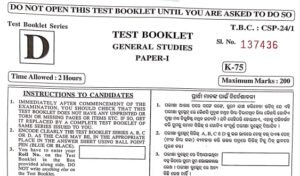
Test Booklet Series: A
TEST BOOKLET
CSE: 2025-26
GENERAL STUDIES PAPER – I
(Time Allowed: 2 Hours)
(Maximum Marks: 200)
1. Consider the following statements with respect to doctrine of “procedure established by law” as provided in the Constitution of India.
I. It protects against executive action.
II. It protects against legislative action.
III. Article 22 was incorporated to the Constitution as additional safeguards after debate in the Constituent Assembly.
IV. In the Bank Nationalisation Case, the Supreme Court adopted its strict interpretation.
How many of the above statement(s) is/are correct?
(A) Only 1
(B) Only 2
(C) Only 3
(D) All 4
ANSWER: B
EXPLANATION
Statement I is correct: The doctrine of “procedure established by law” (borrowed from the Japanese Constitution and enshrined in Article 21) protects an individual strictly against arbitrary executive action. If the executive deprives a person of life or personal liberty without the authority of a valid law, the courts will strike it down.
Statement II is incorrect: Unlike the American doctrine of “due process of law,” the narrow doctrine of “procedure established by law” does not protect against arbitrary legislative action. Under this doctrine (as originally interpreted in the A.K. Gopalan case, 1950), as long as the legislature is competent to enact a law and follows the prescribed legislative procedure, the courts cannot question the substantive fairness, justice, or reasonableness of that law. (Note: Protection against arbitrary legislative action was later read into Article 21 by the Supreme Court in the Maneka Gandhi case, 1978, effectively introducing “due process”).
Statement III is correct: During the Constituent Assembly debates, dropping the phrase “due process of law” in favor of “procedure established by law” in Draft Article 15 (now Article 21) sparked widespread concern that the legislature would gain unchecked power to pass oppressive laws affecting personal liberty. To address these apprehensions, Dr. B.R. Ambedkar introduced Draft Article 15A — enacted as Article 22 — to provide explicit procedural safeguards against arbitrary arrest and detention.
Statement IV is incorrect: In R.C. Cooper vs. Union of India (1970), commonly known as the Bank Nationalisation Case, the Supreme Court actually abandoned the strict, isolated interpretation of Fundamental Rights established in A.K. Gopalan (1950). The Court held that Fundamental Rights are not mutually exclusive water-tight compartments and that a law depriving a person of property or liberty must also satisfy the test of reasonableness under Articles 14 and 19—paving the way for the broader “due process” standard later solidified in Maneka Gandhi (1978).
Therefore, only Statements I and III are correct.
2. Which of the following initiatives launched recently by the Government of India is NOT directly associated with carbon trading or emissions reduction mechanism?
(A) Indian Carbon Market Portal
(B) Perform, Achieve and Trade (PAT) Scheme
(C) Prakriti
(D) National Carbon Registry
ANSWER: C
EXPLANATION
(C) Prakriti (Correct Answer): Launched by the Ministry of Environment, Forest and Climate Change (MoEFCC), Prakriti is a mass awareness initiative aimed at encouraging small, sustainable lifestyle changes among citizens—most notably the elimination of single-use plastics (SUP) and promoting eco-friendly habits. Unlike the other options, it is a behavioral awareness campaign rather than a regulatory, market-based carbon trading, or industrial emissions reduction mechanism. (Note: While “PRAKRITI” was also used as the title for an international conference on carbon markets, as a government initiative/mascot, it pertains to plastic waste management and green lifestyle awareness.)
(A) Indian Carbon Market (ICM) Portal: A dedicated digital platform developed by the Bureau of Energy Efficiency (BEE) to operationalize India’s Carbon Credit Trading Scheme (CCTS). It manages entity registration, Monitoring, Reporting, and Verification (MRV), and the issuance of Carbon Credit Certificates (CCCs).
(B) Perform, Achieve and Trade (PAT) Scheme: A flagship market-based mechanism under the National Mission for Enhanced Energy Efficiency (NMEEE) that sets mandatory specific energy consumption targets for energy-intensive industries (Designated Consumers) and allows them to trade Energy Saving Certificates (ESCerts)—directly reducing industrial emissions and serving as the precursor to India’s carbon market.
(D) National Carbon Registry: Operated by the Grid Controller of India Limited (Grid-India) under the CCTS framework, it serves as the centralized digital ledger that tracks the issuance, transfer, trading, and retirement of Carbon Credit Certificates (CCCs) to prevent double-counting.
3. Consider the following statements regarding desert climate and soils :
1. Aridisols show significant leaching due to rainfall.
2. Desert soils are often coarse- textured and well-drained.
3. Entisols are highly developed soils with multiple horizons.
Which of the statements given above is/are correct?
(A) 2 only
(B) 1 and 3 only
(C) 2 and 3 only
(D) 1,2 and 3
ANSWER: A
EXPLANATION
Statement 1 is incorrect: Aridisols are the dominant soils of arid and desert regions where evapotranspiration far exceeds precipitation. Because rainfall is minimal, leaching is negligible. Instead of soluble minerals washing downward out of the soil profile, high evaporation draws groundwater upward via capillary action, leading to the accumulation of calcium carbonate (calcification) and soluble salts (salinization) near the surface.
Statement 2 is correct: Desert soils form largely through mechanical (physical) weathering—such as thermal expansion and wind abrasion—rather than chemical weathering. Consequently, they are rich in sand and gravel, making them coarse-textured with large pore spaces that allow water to infiltrate rapidly (well-drained), though they lack organic matter (humus) and moisture-retention capacity.
Statement 3 is incorrect: Entisols are mineral soils with little to no profile development and lack distinct pedogenic horizons (often possessing only a faint surface A horizon directly over parent material, R or C). In deserts, they commonly occur on active sand dunes, alluvial fans, and rocky slopes where continuous wind erosion, deposition, or extreme aridity prevents soil horizons from maturing.
4. Consider the following statements with respect to IPCC assessment.
I. IPCC was established by UNEP and WMO
II. IPCC directly enforces emission reductions
III. Fifth Assessment Report highlights rapid warming since 1950s
IV. IPCC provides a scientific basis for policymaking
How many of the above statement(s) is/are true?
(A) Only 1
(B) Only 2
(C) Only 3
(D) All 4
ANSWER: C
EXPLANATION
5. Consider the following statements with respect to Prashast 2.0?
I. A mobile App launched by the Ministry of Social Justice and Empowerment.
II. To screen school children with respect to 20 types of disabilities under the RPwD Act, 2016.
III. Aims at early screening and intervention in integrating the identified children to the social, behavioural and mainstream educational environment.
IV. Its integration with UDISE+ is pending.
How many of the above statement(s) is/are true?
(A) Only 1
(B) Only 2
(C) Only 3
(D) All 4
ANSWER: B
EXPLANATION
6. Consider the following match with respect to “Aapki Poonji, Aapka Adhikar” campaign to reclaim the unclaimed financial assets.
I. Bank Deposit – UDGAM Portal
II. Insurance Proceeds – Bima Kiran Portal
II. Mutual Fund Investment -MITRA Portal
IV. Dividends and shares – SEBI Portal
How many of the above is/are correctly matched?
(A) Only 1
(B) Only 2
(C) Only 3
(D) All 4
ANSWER: B
EXPLANATION
I. Bank Deposit – UDGAM Portal (Correct): The Reserve Bank of India (RBI) operates the UDGAM (Unclaimed Deposits – Gateway to Access Information) portal to help citizens search and reclaim unclaimed bank deposits across multiple banks.
II. Insurance Proceeds – Bima Kiran Portal (Incorrect): Unclaimed insurance proceeds are tracked and claimed through IRDAI’s Bima Bharosa portal (or individual insurer websites), not “Bima Kiran”.
III. Mutual Fund Investment – MITRA Portal (Correct): SEBI launched the MITRA (Mutual Fund Investment Tracing and Retrieval Assistant) platform to help investors trace inactive and unclaimed mutual fund folios.
IV. Dividends and shares – SEBI Portal (Incorrect): Unclaimed dividends and shares transferred after seven years are reclaimed through the IEPFA (Investor Education and Protection Fund Authority) portal under the Ministry of Corporate Affairs, rather than a SEBI portal.
7. Match the following Biosphere Reserves with their corresponding State (List-I) and year for national designation of India (List-II):
| List-I(Biosphere Reserve and State) | List – II (Year of designation) |
| (a) Panna, Madhya Pradesh | 1. 1988 |
| (b) Nanda Devi, Uttarakhand | 2. 2011 |
| (c) Agasthyamalai, Tamil Nadu and Kerala | 3. 2009 |
| (d) Cold Desert, Himachal Pradesh | 4. 2001 |
Select the correct answer using the code given below :
(a) (b) (c) (d)
(A) 1 2 3 4
(B) 2 3 1 4
(C) 2 1 3 4
(D) 2 1 4 3
ANSWER: D
EXPLANATION
(a) Panna, Madhya Pradesh — 2. 2011: Panna was designated as India’s 18th national Biosphere Reserve in 2011.
(b) Nanda Devi, Uttarakhand — 1. 1988: Nanda Devi was designated as a national Biosphere Reserve in 1988 (making it the second in India after Nilgiri).]
(c) Agasthyamalai, Tamil Nadu and Kerala — 4. 2001: Located in the southern Western Ghats, it was designated as a national Biosphere Reserve in 2001.
(d) Cold Desert, Himachal Pradesh — 3. 2009: Encompassing the Pin Valley National Park and surrounding regions in Himachal Pradesh, it was designated in 2009.
8. With reference to _ pipeline transportation of oil, consider the following statements:
I. In regions such as Europe, Russia, West Asia and India, pipelines are widely used to transport crude oil from oil wells to refineries and ports.
II. Pipeline networks are generally absent in Central Asian countries due to difficult terrain and political constraints.
III. Turkmenistan has developed pipeline connectivity extending to Iran and parts of China.
Which of the statements given above is/are correct?
(A) I only
(B) I and III only
(C) II and II only
(D) I, II and III
ANSWER: B
EXPLANATION
Thus, Statements I and III are correct.
9. With reference to the World Trade Organisation (WTO), consider the following statements :
I. Its headquarters are located in Geneva, Switzerland.
II. As of December 2024, it has 166 member countries.
III. India is a founding member of the organisation.
IV. It was established in 1945 along with the United Nations system.
Which of the statements given above are correct?
(A) I and III only
(B) I, Il and III only
(C) II and IV only
(D) I, II, III and IV
ANSWER: C
EXPLANATION
Statement I (Correct). The World Trade Organisation (WTO) is headquartered at the Centre William Rappard in Geneva, Switzerland.
Thus, Statements I, II, and III are correct.
10. Consider the following major Ports of the World (List-I) and match them with their correct functional classification (List-I):
List – I List – II
(Port) (Functional Type)
(a) Maracaibo, 1. Entrepot Port
Venezuela
(b) Rotterdam, 2. Oil Port
Europe .
(c) Kochi, India 3. Ports of Call
(d) Aden, Yemen) 4. Naval Port
Select the correct answer using the
code given below:
(a) (b) (c) (d)
(A) 3 1 4 2
(B) 3 4 1 2
(C) 4 1 2 3
(D) 2 1 4 8
ANSWER: D
EXPLANATION
(a) Maracaibo, Venezuela — 2. Oil Port: Lake Maracaibo in Venezuela is a classic example of a tanker port specialized in processing and shipping crude oil.
(b) Rotterdam, Europe — 1. Entrepot Port: Located in the Netherlands, Rotterdam acts as a major collection center where goods are brought from different countries for export across Europe.
(c) Kochi, India — 4. Naval Port: Kochi (Cochin) serves as a strategic naval base (headquarters of the Southern Naval Command of the Indian Navy) with dedicated naval dockyards.
(d) Aden, Yemen — 3. Ports of Call: Historically developed on main sea routes, Aden serves as a classic port of call where ships anchor for refueling, watering, and taking on food items.
11. Consider the following statements about education policy and learning outcomes in India and Odisha:
I. NEP 2020 recommends home language/mother tongue as medium of instruction until at least Grade 5, but Odisha faces challenges due to multiplicity of tribal languages.
II. Odisha’s “Mo School Abhiyan” has been successful in mobilizing alumni funds for infrastructure, but studies show weak correlation between infrastructure and learning outcomes without pedagogical reform.
I. ASER 2023 for Odisha shows that while enrollment remains high (>95%), the proportion of Class 3 children who can read a Class 2 level text has declined compared to pre-COVID levels.
IV. Odisha’s “Siksha Sahayata Yojana” provides scholarships for higher education to SC/ST/ OBC students, but renewal requires 75% attendance, which is difficult for wage laborers.
How many of the above statement(s) is/are correct?
(A) Only 1
(B) Only 2
(C) Only 3
(D) All 4
ANSWER: D
EXPLANATION
Statement I (Correct). The National Education Policy (NEP) 2020 recommends the home language or mother tongue as the medium of instruction until at least Grade 5. Odisha has over 60 tribal communities and dozens of spoken tribal languages, which creates practical challenges in teacher training and textbook availability.
Statement II (Correct). Odisha’s Mo School Abhiyan successfully mobilizes alumni and community funds with matching government grants for school infrastructure. However, educational assessments indicate that infrastructure upgrades alone show a weak correlation with foundational learning gains unless paired with classroom pedagogical reforms.
Statement III (Correct). ASER findings for Odisha show that while school enrollment remains very high (above 95%), foundational reading levels—such as the proportion of Class 3 children able to read a Class 2 level text—declined compared to pre-COVID levels.
Statement IV (Correct). Odisha’s Gopabandhu Sikhya Sahayata Yojana and related post-matric scholarships provide financial assistance for higher education to underprivileged and SC/ST/OBC students. Renewal mandates a minimum 75% attendance threshold, which creates hurdles for students from households reliant on seasonal or migratory wage labor.
Thus, all 4 statements are correct.
12. Who said “The Arab invasion of Sindh is a triumph without results”?
(A) Vinsent Smith
(B) Stanley Lane Poole
(C) Sir Jadunath Sarkar
(D) Irfan Habib
ANSWER: B
EXPLANATION
Attribution: The British historian Stanley Lane-Poole famously described the Arab conquest of Sindh (712 CE) led by Muhammad bin Qasim as “an episode in the history of India and of Islam, a triumph without results.”
Reasoning Behind the Remark: He argued that while the conquest was a military success, its political impact on the Indian subcontinent was limited, as Arab rule remained confined to Sindh and Multan for nearly three centuries without expanding further into mainland India.
13. Who confessed: The defeats of many Billies and Braithwaites will not destroy them. I can ruin their resources by land, but I cannot dry up the sea?
(A) Haider
(B) Tipu Sultan
(C) Sher Singh
(D) Anwar-ud-din
ANSWER: A
EXPLANATION
Attribution: Haider Ali, the ruler of Mysore, made this famous remark during the Second Anglo-Mysore War (1780–1784).
Meaning Behind the Quote: Despite inflicting devastating land defeats on British commanders—specifically Colonel William Baillie (“Billies”) at the Battle of Pollilur (1780) and Colonel John Braithwaite at Annagudi near Tanjore (1782)—Haider Ali recognized that he could not decisively defeat the British East India Company without naval supremacy, as they could continuously replenish men and supplies by sea.
14. The Mahalwari system in Odisha was introduced in which district?
(A) Jajpur
(B) Balasore
(C) Cuttack
(D) Sambalpur
ANSWER: D
EXPLANATION
Regional Division: During the British colonial era, Odisha was governed under three different administrative units—the Bengal Presidency (coastal districts), the Madras Presidency (southern districts), and the Central Provinces (western districts).
Introduction of Mahalwari: Because Sambalpur formed part of the Central Provinces, the British implemented the Mahalwari land revenue system there (with village headmen known locally as Gauntias collecting revenue).
Other Systems in Odisha: In contrast, coastal districts like Cuttack, Balasore, and Jajpur (part of the Bengal Presidency) were governed under the Zamindari (Temporary/Permanent Settlement) system, while southern districts under Madras followed the Ryotwari system.
15. The opening of College in Cuttack took place in which year?
(A) 1865-66 AD
(B) 1867 AD
(C) 1868 AD
(D) 1869 AD
ANSWER: C
EXPLANATION
Establishment: The first college in Odisha—originally known as Cuttack College (and later renamed Ravenshaw College in 1878 after Commissioner T.E. Ravenshaw)—was opened in January 1868.
Background: Following the devastating Na’anka Famine of 1866, the British administration upgraded the existing Cuttack Zilla School (founded in 1841) to intermediate/collegiate status (affiliated with Calcutta University) to expand higher education in the region.
16. Examine the following statements.
Statement-I: The Courts are prohibited to inquire to the advice given by the Ministers to the Governor
Statement-II : The Ministers have no legal responsibility as per the constitutional provision.
In the above context, which one of the following is correct?
(A) Both Statement-I and Statement- II are correct and Statement-II is the correct explanation for Statement-I.
(B) Both Statement-I and Statement- II are correct but Statement-II is not the correct explanation for Statement-I.
(C) Statement-I is correct but Statement-II is incorrect.
(D) Statement-I is incorrect but Statement-II is correct.
ANSWER: A
EXPLANATION
Statement-I (Correct): Under Article 163(3) of the Indian Constitution, the question whether any, and if so what, advice was tendered by Ministers to the Governor shall not be inquired into in any court.
Statement-II (Correct): Unlike Britain—where every official act of the Monarch must be countersigned by a Minister who is legally responsible for it—the Indian Constitution does not establish a system of legal responsibility for Ministers. Ministers are not required to countersign official orders of the Governor, nor can they be held legally liable in court for the advice tendered.
Connection: Because courts are expressly barred under Article 163(3) from inquiring into the nature of ministerial advice, it becomes impossible to ascertain in court which Minister advised a particular act—directly establishing and explaining why Ministers bear no legal responsibility in India (as noted in standard Indian Polity texts like M. Laxmikanth).
17. Consider the following statements regarding aquatic organisms:
1. Plankton are small organisms that float in water.
2. Nekton includes organisms that actively swim in water.
3. Benthos are organisms that live suspended in the water column.
Which of the statements given above is/are correct?
(A) 1 and 2 only
(B) 2 and 3 only
(C) 1 only
(D) 1,2 and 3
ANSWER: A
EXPLANATION
Statement 1 (Correct): Plankton are microscopic or small organisms (such as phytoplankton and zooplankton) that float or drift passively in water currents because they have limited or no ability to swim against them.
Statement 2 (Correct): Nekton consists of larger, active swimmers (such as fish, whales, turtles, and squids) that can move independently of water currents.
Statement 3 (Incorrect): Benthos are organisms that live on, in, or near the bottom (seafloor or riverbed) of a water body (such as crabs, starfish, clams, and corals), rather than suspended in the open water column.
Thus, Statements 1 and 2 are correct.
18. With reference to cyclones, consider:
1. Cyclones form when sea temperature exceeds -27°C
2. High-pressure zones initiate cyclones
3. Wind spirals inward towards low-pressure centre
4. Cyclones move toward regions of higher pressure
5. Cyclones derive energy from ocean heat
Which of the above are true?
(A) 1,3 and 5 only
(B) 1,2 and 4 only
(C) 2,3 and 5 only
(D) 1,3,4 and 5 only
ANSWER: * / A
EXPLANATION
Statement 1 (Correct): Tropical cyclones require a large sea surface with temperatures higher than 27°C to provide sufficient warmth and moisture for deep convection. (Note: Statement 1 contains a minor OCR/typographical artifact ~27°C rendered as -27°C, referring to sea surface temperatures exceeding 27°C).
Statement 2 (Incorrect): Cyclones are initiated around intense low-pressure zones (depressions), whereas high-pressure zones create anticyclonic conditions with descending air and clear skies.
Statement 3 (Correct): Air rushes inward from surrounding high-pressure areas toward the low-pressure center, spiraling cyclonically (counter-clockwise in the Northern Hemisphere and clockwise in the Southern Hemisphere) due to the Coriolis force.
Statement 4 (Incorrect): Tropical cyclones are primarily steered by large-scale atmospheric winds (such as trade winds and subtropical ridges) rather than simply moving toward regions of higher pressure.
Statement 5 (Correct): Tropical cyclones derive their primary energy from the latent heat of condensation released as warm, moist air rising from the ocean surface condenses into clouds.
Thus, Statements 1, 3, and 5 are true.
19. Consider the following statements regarding outcomes of COP30:
1. The Belém Package focuses primarily on setting new binding emission targets.
2. The Global Mutirao Agreement prioritises implementation over ambition.
3. The Just Transition Mechanism includes legally guaranteed financial commitments.
4. The Global Implementation Tracker is intended to assess alignment with the 1.5°C pathway.
Which of the statements given above are correct?
(A) 1 and 4 only
(B) 1,2 and 3 only
(C) 2,3 and 4 only
(D) 2 and 4 only
ANSWER: D
EXPLANATION
Statement 1 (Incorrect): The Belém Package—comprising 29 consensus decisions adopted at COP30 in Belém, Brazil—focuses on accelerating Paris Agreement implementation, adaptation finance, forest conservation, and cooperation rather than establishing new binding emission targets.
Statement 2 (Correct): The Global Mutirão Agreement serves as the political backbone of COP30. Built around the Brazilian concept of collective mobilization (mutirão), it shifts focus from setting new mandatory targets to prioritizing practical delivery and implementation over ambition.
Statement 3 (Incorrect): While COP30 agreed to establish a Just Transition Mechanism for international cooperation, technical assistance, and capacity-building, it does not include legally guaranteed financial commitments from developed nations.
Statement 4 (Correct): The Global Implementation Tracker (alongside the Global Implementation Accelerator and Belém Mission to 1.5°C) is designed to monitor real-world progress and assess whether national and global actions stay aligned with the 1.5°C pathway.
Thus, Statements 2 and 4 are correct.
20. India integrates biodiversity finance with development planning.
Question: This best reflects:
(A) Greenwashing
(B) Sustainable development
paradigm
(C) Command economy
(D) Fiscal federalism
ANSWER: B
EXPLANATION
Sustainable Development Paradigm (Correct): Integrating biodiversity conservation and natural capital financing directly into mainstream economic and development planning ensures that economic growth progresses alongside ecological protection, which is the core principle of sustainable development.
Greenwashing (Incorrect): Greenwashing refers to deceptive marketing or false claims made by organizations to appear environmentally friendly without taking meaningful ecological action.
Command Economy (Incorrect): A command economy is a centralized economic system where a government controls production, pricing, and resource allocation, rather than an approach to environmental integration.
Fiscal Federalism (Incorrect): Fiscal federalism deals with the division of financial powers, taxation, and expenditure responsibilities across different tiers of government (Union, State, and Local), not biodiversity-development integration.
21. Which of the two Articles of Indian Constitution override Fundamental Rights in respect of Article 14 Right to Equality and State level Economic Redistribution
(A) Art. 300 (a) & (d)
(B) Art. 39 (b) and (c)
(C) Art. 18 (2) & (4)
(D) Art. 19(c) and(d)
ANSWER: B
EXPLANATION
Constitutional Explanation
Article 31C & Economic Redistribution: Under Article 31C of the Indian Constitution (inserted by the 25th Amendment Act, 1971), any law enacted to give effect to the Directive Principles of State Policy specified in Article 39(b) and Article 39(c) cannot be declared void on the ground that it infringes upon the Fundamental Rights conferred by Article 14 (Right to Equality) or Article 19 (Right to Freedom).
Provisions of Article 39(b) & 39(c):
Article 39(b): Directs the State to ensure that the ownership and control of the material resources of the community are so distributed as best to subserve the common good.
Article 39(c): Directs the State to ensure that the operation of the economic system does not result in the concentration of wealth and means of production to the common detriment.
22. In which Article of Indian Constitution the ‘Doctrine of Estoppel’ is found ?
(A) Art. 115
(B) Art. 117
(C) Art. 123
(D) None of the Article in the Constitution
ANSWER: D
EXPLANATION
The Doctrine of Estoppel is a rule of evidence rather than a constitutional provision. In India, it is codified under Section 115 of the Indian Evidence Act, 1872 (and carried forward into the Bharatiya Sakshya Adhiniyam), which prevents a person from denying the truth of a statement or representation they previously made if another person has acted upon it.
23. Under whose Prime Ministership the ; nomenclature of’ Prime Minister’s Secretariat’ was changed to ‘Prime Minister’s Office’?
(A) Atal Bihari Vajpayee
(B) Morarji Desai
(C) Indira Gandhi
(D) P.V. Narasimha Rao
ANSWER: B
EXPLANATION
The Prime Minister’s Secretariat (PMS) was renamed the Prime Minister’s Office (PMO) in June 1977 during the tenure of Prime Minister Morarji Desai.
24. Consider the following with respect to pygmy hog (porcula salvania).
I. It is the rarest species of wild pig.
II. It inhabits in the tall, dense, wet alluvial grasslands of Himalayan Southern foothills.
III. It is a critically endangered species as per IUCN Red List.
IV. Their conservation was started by the trust founded by Gerald Durrell.
How many of the above is/are correct?
(A) Only 1
(B) Only 2
(C) Only 3
(D) All 4
ANSWER: C
EXPLANATION
25. Consider the following statements about the Mpemba effect.
I. Freezing of hotter water faster than colder water under specific conditions.
II. JLN Advanced Scientific Research has used supercomputers to develop the first simulation of ice formation proving the Mpemba effect of water.
Ill. Named after Nigerian scientist Erasto Mpemba, who rediscovered it in 1969.
IV. Aristotle, Robert Hooke and Descartes have noted about this experiment earlier.
V. Relaxation of materials due to sudden temperature changes is technically called out-of-equilibrium phenomena.
How many of the above statements are true?
(A) Only 1
(B) Only 2
(C) Only 3
(D) Only 4
ANSWER: D
EXPLANATION
26. Presently a 9-Judges Bench of the Supreme Court is hearing the Sabarimala reference. Consider the following statements relevant to the 9-Judges Bench of the Supreme Court.
I. It is as per the Article 145(3) of the Constitution.
II. KS Puttaswamy vs. UOI case
Il. Indra Sawhney & Ors vs. UOI & Ors case
IV. S.R.Bommai & Ors vs. UOI & Ors Case
How many of the above are correct?
(A) Only 1
(B) Only 2
(C) Only 3
(D) All 4
ANSWER: D
EXPLANATION
All four statements are factually correct and directly relate to 9-Judge Constitution Benches of the Supreme Court of India.
Statement-by-Statement Breakdown
27. Which of the following statements about the Children’s Booker Prize is NOT correct:
1) It will be awarded annually from 2027
2) It will be awarded annually from 2028
3) The founding partner and principal funder of it is the AKO Foundation
4) The founding partner and principal funder of it is the TVS Foundation
Select the correct answer from the codes given below:
(A) 2 and 4 only
(B) 1 and 3 only
(C) 2 only
(D) 4 only
ANSWER: A
EXPLANATION
28. Which one of the following processes involves a decrease in entropy?
(A) Burning of coal in air
(B) Formation of NH3 from H2 and N2
(C) Evaporation of water
(D) Melting of ice
ANSWER: B
EXPLANATION
Entropy measures the degree of randomness or disorder in a system. A decrease in entropy occurs when particles become more ordered or when the total number of gas molecules decreases during a chemical reaction.
Option-by-Option Breakdown
29. With reference to the geomorphological evolution of the Peninsular Plateau of India, match the following hill ranges (List-I) with their corresponding geomorphological origin and characteristics (List-ID:
List – I List – II
(Hill Range) (Type/Characteristic)
(a) Aravalli 1. Highly Range denuded remnant of an ancient fold mountain system (residual mountain)
(b) Nallamala 2. Structural hill Hills range forming a major segment of the Eastern Ghats
(c) Javadi Hills 3. Dissected plateau remnant representing fragmented Eastern Ghats
(d) Mahendragiri 4. North-eastern Hills discontinuous extension the Eastern Ghats near the coastal plain
Codes:
(a)(b)(c)(d)
(A) 3 2 1 4
(B) 1 2 3 4
(C) 1 3 2 4
(D) 2 1 3 4
ANSWER: B
EXPLANATION
30. Consider the following statements regarding the statutory definition of “disaster” as provided under the Disaster Management Act, 2005:
1. It covers events arising from both natural and anthropogenic causes, including those due to accidents or negligence.
2. It necessarily entails a large- scale loss of human life for an event to be classified as a
disaster.
3. It includes damage to property, the environment and resultant human suffering.
4. It is characterised by an occurrence of such nature or magnitude that it exceeds the coping capacity of the affected community.
Which of the statements given above is/are correct?
(A) 1 and 2 only
(B) 1,3 and 4 only
(C) 2, 3 and 4 only
(D) 1, 2,3 and 4
ANSWER: B
EXPLANATION
Under Section 2(d) of the Disaster Management Act, 2005, a “disaster” is defined as a catastrophe, mishap, calamity, or grave occurrence in any area, arising from natural or man-made causes, or by accident or negligence, which results in substantial loss of life or human suffering or damage to, and destruction of, property, or damage to, or degradation of, environment, and is of such a nature or magnitude as to be beyond the coping capacity of the community of the affected area.
Statement-wise Analysis
31. With reference to oilseeds in India, consider the following statements :
I. Oilseeds are cultivated primarily for the extraction of edible oils.
II. Dryland regions such as Malwa Plateau, Marathwada, Gujarat and Rajasthan are important oilseed- growing areas.
III. Oilseeds occupy about one-third of the total cropped area in India.
IV. Groundnut, rapeseed and mustard, soybean and sunflower are major oilseed crops in India.
How many of the above is/are CORRECT?
(A) Only 1
(B) Only 2
(C) Only 3
(D) All 4
ANSWER: C
EXPLANATION
32. Which one of the following correctly describes the geographical behaviour of Bahuda, Vansadhara and Nagavali rivers?
(A) They originate in Chhattisgarh and flow through Odisha to Andhra Pradesh
(B) They originate in Odisha and terminate within the state
(C) They originate in Odisha and flow into Andhra Pradesh before joining the Bay of Bengal
(D) They originate in Andhra Pradesh and flow into Odisha
ANSWER: C
EXPLANATION
33. With reference to the power sector in Odisha, the Odisha Power Generation Corporation (OPGC) plays a significant role in thermal power generation in the state.
In this context, OPGC was incorporated on:
(A) 1st January 1985
(B) 14th November 1984
(C) 26th January 1986
(D) 15th August 1983
ANSWER: B
EXPLANATION
34. Consider the following description of a demographic trend in India: “Between 1971 and 2021, India’s Total Fertility Rate (TFR) declined from 5.2 to 2.0. During the same period, the proportion of the population aged 60 years and above increased from 5% to over 10%. The working-age population (15-59 years) peaked around 2020 and is projected to begin declining after 2040.”
Based on this description, which of the ‘ following statements is most accurate?
(A) India has already entered the fourth stage of demographic transition.
(B) The demographic dividend window in India is now closed because the working-age population has already started declining.
(C) India’s TFR is still above replacement level (2.1), so the population will continue to grow indefinitely.
(D) The increase in elderly population means India will face ageing-related challenges even while the working-age population is still large.
ANSWER: D
EXPLANATION
(D) is correct. As the passage notes, the share of the population aged 60 and above has already doubled from 5% to over 10%, while the working-age population (15–59 years) remains high until it begins declining after 2040. This creates a dual demographic challenge where India must manage rising elderly care, healthcare, and pension needs alongside creating jobs for a large working-age cohort.
(A) is incorrect. In the Demographic Transition Model, the fourth stage is characterized by low birth rates, low death rates, and a stabilized or shrinking total population. India is currently in the late third stage (declining birth rates and low death rates, though total population continues to grow due to population momentum).
(B) is incorrect. The passage explicitly states that the working-age population is projected to begin declining after 2040, meaning India’s demographic dividend window remains open for the next decade and a half.
(C) is incorrect. A Total Fertility Rate (TFR) of 2.0 is already below the replacement level of 2.1, meaning the population will eventually stabilize and decline rather than grow indefinitely.
35. Consider the following statements about targeting and leakage in poverty alleviation programs in India and Odisha :
I. Aadhaar-based biometric authentication for PDS in Odisha has reduced duplicate ration cards, but studies show increased exclusion errors for elderly and tribal populations.
II. Odisha’s “One Nation One Ration Card” (ONORC) implementation allows migrant workers from Odisha to access subsidized grains in destination states.
III. DBT for MGNREGS wages in Odisha has reduced corruption but not significantly reduced delays, as fund release remains sequential.
IV. SECC 2011 data, still used for targeting, has not been updated, leading to inclusion of households that have exited poverty and exclusion of new poor.
How many of the above statement is/are correct?
(A) Only 1
(B) Only 2
(C) Only 3
(D) All 4
ANSWER: D
EXPLANATION
Statement I is correct: Aadhaar-based biometric authentication (ABBA) in the Public Distribution System (PDS) has helped eliminate duplicate and ghost ration cards, but studies and field reports show that technical glitches (such as fingerprint mismatches and internet connectivity issues) lead to exclusion errors, disproportionately affecting vulnerable groups like the elderly and tribal populations.
Statement II is correct: The One Nation One Ration Card (ONORC) scheme provides inter-state and intra-state portability, allowing migrant workers from Odisha to claim their National Food Security Act (NFSA) foodgrain entitlements at Fair Price Shops (FPS) in destination states.
Statement III is correct: Direct Benefit Transfer (DBT) for MGNREGS wages has helped plug leakages and reduce corruption by sending money directly to accounts, but systemic payment and wage delays persist largely because the fund release mechanism remains multi-tiered and sequential.
Statement IV is correct: The Socio-Economic and Caste Census (SECC 2011) data has remained outdated and unrevised for years, causing persistent targeting errors—including the inclusion of non-poor households who have since moved out of poverty and the exclusion of newly impoverished families.
36. Population distribution between rural and urban areas is best represented using which of the following graphical methods?
(A) Hythergraph
(B) Ergograph
(C) Dots and spheres
(D) Line graph
ANSWER: C
EXPLANATION
Dots and spheres. In cartography and geography, combining dots and spheres is the standard method for showing rural and urban population distribution together on a single map. Uniformly sized dots represent the scattered rural population, while three-dimensional spheres (with radii scaled to the cube root of the population) represent large, concentrated urban centers without overcrowding the map.
Hythergraph. This graph displays the relationship between monthly temperature and humidity (or rainfall) to study climate, not population.
Ergograph. This chart records human work capacity, muscular exertion, or agricultural activity cycles over time.
Line graph. Line graphs show continuous trends over time, such as population growth rates across decades, rather than spatial distribution across rural and urban areas.
37. Match the correct pair for List-I and List-II
List-I
a.Monetarism
b. Employment Multiplier
c. Multiplier effect of balanced budget
d. Rational expectation Hypothesis
List-II
I. R. F Kahn
II. T. Havelmo
III. John Muth
IV. Milton Friedman
Codes :
| a | b | c | d | |
| (A) | II | IV | III | I |
| (B) | IV | I | II | III |
| (C) | I | III | IV | II |
| (D) | III | II | I | IV |
ANSWER: B
EXPLANATION
a. Monetarism — IV. Milton Friedman: Milton Friedman is the founder and leading proponent of the Monetarist school of economic thought, emphasizing the role of governments in controlling the amount of money in circulation.
b. Employment Multiplier — I. R. F. Kahn: Richard Ferdinand Kahn introduced the concept of the Employment Multiplier in his famous 1931 paper, which later inspired John Maynard Keynes’s investment multiplier.
c. Multiplier effect of balanced budget — II. T. Haavelmo: Trygve Haavelmo formulated the Balanced Budget Multiplier theorem in 1945, showing that an equal increase in government spending and taxes still stimulates aggregate output.
d. Rational expectation Hypothesis — III. John Muth: John F. Muth first proposed the Rational Expectations Hypothesis in 1961, arguing that economic agents form expectations based on all available information and rational forecasts rather than purely past trends.
38. Consider the following pairs :
I. Mudrarakshasa : Narrates the ascent of Samudragupta to power
II. Malavikagnimitram: Drama by Kalidasa about the Sunga ruler Agnimitra
III. Milindapanho: Conversation between Menander and Nagasena
IV. Dathavamsa: A Buddhist Ceylonese Chronicle of Tooth Relic
How many pair(s) is/are WRONGLY
matched?
(A) Only 1
(B) Only 2
(C) Only 3
(D) None
ANSWER: A
EXPLANATION
Pair I is WRONGLY matched: Mudrarakshasa, a Sanskrit play written by Vishakhadatta, narrates the ascent of Chandragupta Maurya to power in Magadha with the help of Chanakya, not Samudragupta.
Pair II is correctly matched: Malavikagnimitram is a famous Sanskrit drama written by Kalidasa that depicts the love story of Agnimitra, the second ruler of the Sunga dynasty, and Malavika.
Pair III is correctly matched: Milindapanho (Questions of Milinda) is a Buddhist text recording a philosophical dialogue between the Indo-Greek king Menander I (Milinda) and the Buddhist sage Nagasena.
Pair IV is correctly matched: Dathavamsa is a 12th-century Pali chronicle written in Sri Lanka (Ceylon) by Dhammakitti that recounts the history of the Tooth Relic of the Buddha.
39. Match the columns:
I. Annie Besant :First Indian woman to become Congress President in 1925
II. Badruddin Tyabji : First Muslim
President of Congress in 1887
III. Mahatma Gandhi : Presided over
the Belgaum session of Congress in 1924
IV. Syed Ahmed Khan: Earned the knighthood in 1888
How many pairs given above are correctly matched?
(A) Only 1
(B) Only 2
(C) Only 3
(D) All 4
ANSWER: C
EXPLANATION
Pair I is incorrectly matched. Annie Besant became the first woman (not the first Indian woman) to preside over the Indian National Congress at the Calcutta session in 1917. The first Indian woman to become Congress President was Sarojini Naidu at the Kanpur session in 1925.
Pair II is correctly matched. Badruddin Tyabji became the first Muslim President of the Indian National Congress when he presided over its third session in Madras in 1887.
Pair III is correctly matched. Mahatma Gandhi presided over the Indian National Congress only once in his lifetime, at the Belgaum (Belagavi) session in 1924.
Pair IV is correctly matched. Sir Syed Ahmed Khan was awarded a knighthood (KCSI) by the British government in 1888 for his services to education and public life.
40. Match List-I with List-II with respect to language of Indus Valley civilisation and select the answer using the codes given below the lists.
List-I List-II
i) Mahadevan (a) Language was Dravidian and Script relied Upon homophones
ii) SRRao (b) Language is closer to Dravidian than to any other language.
iii) Kinnier-Wilson(c) Accept the Dravidian hypothesis and published an impressive computer concordance
iv) Parpola (d) Attempt to read the contents of the inscriptions in terms of analogies between Harappan and Sumerian signs.
v) Soviet Scholars (e) Attempt to read the script as containing a pre-Indo- Aryan language of the Indo- European family
Codes :
(A) i-a, ii-c, iii-e, iv-d, v-b
(B) i-d, ii-a, iii-b, iv-c, v-e
(C) i-c, ii-e, iii-d, iv-a, v-b
(D) i-b, ii-d, iii-a, iv-e, v-c
ANSWER: C
EXPLANATION
i) Mahadevan — (c) Accepted the Dravidian hypothesis and published an impressive computer concordance: Indian epigraphist Iravatham Mahadevan supported the Dravidian origin theory and published his landmark work, The Indus Script: Texts, Concordance and Tables, in 1977.
ii) S.R. Rao — (e) Attempted to read the script as containing a pre-Indo-Aryan language of the Indo-European family: Archaeologist S.R. Rao proposed that the Harappan language belonged to the Indo-European family and represented an early form of Old Indo-Aryan (archaic Sanskrit) that eventually evolved into Brahmi.
iii) Kinnier-Wilson — (d) Attempted to read the contents of the inscriptions in terms of analogies between Harappan and Sumerian signs: Assyriologist J.V. Kinnier-Wilson analyzed the Indus script by drawing structural and economic comparisons with contemporary Sumerian cuneiform signs.
iv) Parpola — (a) Language was Dravidian and script relied upon homophones: Finnish Indologist Asko Parpola argued that the Indus language was Proto-Dravidian and used the rebus principle, where pictorial signs relied on homophones (words sounding alike) to represent abstract ideas or names.
v) Soviet Scholars — (b) Language is closer to Dravidian than to any other language: A team of Soviet researchers led by Yuri Knorozov conducted statistical and structural analyses in the 1960s, concluding that the script’s grammatical structure aligns closest with the Dravidian language family.
41. Consider the following statements in the speech of Canadian Prime Minister Mark Carney at the World Economic Forum at Davos.
Statement-I: The middle powers must act together.
Statement-II : We are neither at the table nor on the menu.
(A) Both Statement-I and Statement- II are correct and Statement-II is the correct explanation for Statement-I.
(B) Both Statement-I and Statement- II are correct and Statement-II is not the correct explanation for Statement-I
(C) Statement-I is correct but Statement-II is incorrect
(D) Statement-I is incorrect but Statement-II is correct
ANSWER: C
EXPLANATION
Statement-I is correct. During his address at the World Economic Forum in Davos, Canadian Prime Minister Mark Carney warned of a “rupture” in the rules-based global order due to great-power rivalry and economic coercion. He urged countries like Canada and its allies to unite, explicitly stating that “middle powers must act together.”
Statement-II is incorrect. Carney did not say “we are neither at the table nor on the menu.” Instead, he used the classic diplomatic warning to explain why collective action is vital: “because if we’re not at the table, we’re on the menu.” This highlights that middle powers must either sit together at the decision-making table or risk being dominated by the decisions of major superpowers.
42. Which of the following cities acted as the meeting point for trade routes from east to west and from north to south from historical perspective?
(A) Kausambi
(B) Ujjain
(C) Mathura
(D) Paithan
ANSWER: C
EXPLANATION
Mathura: Located at the junction of two major ancient trade routes—the Uttarapatha (the northern route running east-to-west from Taxila in the northwest to Tamralipti in the east) and the Dakshinapatha (the southern route running north-to-south towards the Deccan)—Mathura served as a premier commercial, political, and cultural crossroads in ancient India.
Ujjain: While Ujjain was a major commercial hub located along the Dakshinapatha connecting northern India to the western ports (like Bharuch), NCERT explicitly identifies Mathura as the specific junction where routes from east to west and north to south converged.
Kausambi: Situated near the confluence of the Ganga and Yamuna rivers, it was an important riverine trade center along the Uttarapatha.
Paithan (Pratishthana): Located on the banks of the Godavari river in Maharashtra, it served as the southern terminus of the Dakshinapatha rather than the central crossroads.
43. With reference to the temple architecture of Odisha, consider the following.
I. The Vaidyanath temple near Sonepur has a lofty gateway.
II. The Vaital temple at Bhubaneswar is designed in Khakhara style.
III. The Sun temple at Konark is a living temple.
IV. The Chausath Yogini temple at Hirapur is circular in plan.
How many statements mentioned above are correct?
(A) Only 1
(B) Only 2
(C) Only 3
(D) Only 4
ANSWER: B
EXPLANATION
Statement I is incorrect. The Vaidyanath (Kosaleswar) temple near Sonepur represents early western Odishan (Kosalan) temple architecture, characterized by a sanctum, vestibule, and pillared mandapa rather than a lofty gateway. Towering entrance gateways (gopurams) are a hallmark of Dravidian architecture, not Kalinga or western Odishan temples.
Statement II is correct. The 8th-century Vaital Deula in Bhubaneswar is the most famous example of the Khakhara sub-style of Kalinga architecture, distinguished by its rectangular ground plan and semi-cylindrical, barrel-vaulted roof resembling a khakhara (local pumpkin).
Statement III is incorrect. The Sun Temple at Konark is a non-living temple (archaeological monument) where regular daily worship and rituals are no longer performed, as the main sanctum (vimana) collapsed centuries ago and the surviving jagamohana is sealed off for preservation.
Statement IV is correct. The 9th-century Chausath Yogini Temple at Hirapur (near Bhubaneswar) is a hypaethral (open-to-the-sky) shrine built on a circular plan with 60 peripheral niches housing yogini sculptures and a central Chandi Mandap.
44. With reference to Jayi Rajaguru, consider the following statements.
I. His full name was Jayakrushna Rajaguru Mahapatra.
II. He was the royal preceptor to Mukundadeva II.
III. He mobilized an army of Paiks and revolted against the British East India Company in 1804.
IV. On 6 December 1806 he was executed at Midnapore.
How many statement(s) mentioned above is/are correct?
(A) Only 1
(B) Only 2
(C) Only 3
(D) All 4
ANSWER: D
EXPLANATION
Statement I is correct. His full name was Jayakrushna Rajaguru Mahapatra, and he was born on October 29, 1739, in Biraharekrushnapur near Puri, Odisha.
Statement II is correct. He served as the Rajaguru (royal preceptor), chief minister, and regent to the minor ruler of Khurda, Gajapati Mukundadeva II.
Statement III is correct. In 1804, after the British East India Company breached its agreements regarding the return of key parganas (Lembai, Rahang, and Serai), he organized and mobilized an army of Paiks (traditional landed militia) to revolt against British rule.
Statement IV is correct. Following the fall of Khurda Fort and his subsequent arrest and trial, he was brutally executed by the British at Baghitota in Midnapore on 6 December 1806, earning recognition as the first martyr of Odisha’s freedom struggle.
45. Which literary source mentions Kalinga and Odra along with the sacred river Baitarani and Goddess Viraja?
(A) Vayu Purana
(B) Manu Smriti
(C) The Mahabharata
(D) None of the above
ANSWER: C
EXPLANATION
In the Vana Parva (Forest Book) of the Mahabharata, Sage Lomasa guides the Pandavas during their pilgrimage (Tirtha Yatra) and describes the ancient regions of Kalinga and Odra. He explicitly mentions the sacred Baitarani River as the northern boundary of Kalinga and advises the Pandavas to bathe in its waters and worship Goddess Viraja (at Viraja Kshetra, modern-day Jajpur) to wash away all sins.
Vayu Purana: While the Vayu Purana mentions Kalinga and exalts the Baitarani River and Jajpur (Nabhigaya Kshetra) for ancestral rites (Pinda Daan), it is the Mahabharata that makes the earliest literary reference linking Kalinga, Odra, the Baitarani River, and Goddess Viraja together.
Manu Smriti: This text focuses on social laws, conduct, and legal codes (Dharmashastra) rather than the regional pilgrimage topography of Odisha.
46. Which of the following statement/s is/are NOT correct in respect of the number of Ministers in the Council of Ministers a __________ ?
(1) The total number of Ministers excluding Prime Minister should not exceed 15 percent of the total strength of Lok Sabha
(2) The 91* Constitution Amendment Act introduced a cap on the number of Ministers in the Council of Ministers
(3) The principle of 15% of the total strength of Legislative Assemblies also applicable to States in Indian Union.
(4) The ceiling on the numerical strength of Council of Ministers is limited to 15% of the strength of both the Houses of Parliament.
(A) 1 and 4
(B) 2 and 3
(C) 3 and 4
(D) 2 and 4
ANSWER: A
EXPLANATION
Statement 1 is NOT correct. Under Article 75(1A) of the Indian Constitution, the total number of Ministers—including the Prime Minister (not excluding)—shall not exceed 15 percent of the total strength of the Lok Sabha.
Statement 2 is correct. The 91st Constitutional Amendment Act, 2003 introduced the 15 percent ceiling on the size of the Council of Ministers at both the Union and State levels.
Statement 3 is correct. Under Article 164(1A), the 15 percent cap of the total strength of the State Legislative Assembly applies to States in the Indian Union (with a minimum of 12 ministers, including the Chief Minister).
Statement 4 is NOT correct. The 15 percent numerical ceiling is calculated strictly on the total strength of the Lok Sabha (House of the People) alone, not on the combined strength of both Houses of Parliament (Lok Sabha and Rajya Sabha).
47. Who advanced the slogan, “Ek desh mein do Vidhan, do Pradhan aur Do Nishan nahi chalenge”?
(A) Atal Bihari Vajpayee
(B) VD Savarkar
(C) Deen Dayal Upadhyay
(D) Shyama Prasad Mukherjee
ANSWER: D
EXPLANATION
Shyama Prasad Mukherjee: As the founder of the Bharatiya Jana Sangh, Dr. Shyama Prasad Mukherjee coined and championed the famous slogan “Ek desh mein do Vidhan, do Pradhan aur Do Nishan nahi chalenge” (One country cannot have two constitutions, two prime ministers, and two flags) in 1953. He raised this call during his nationwide movement opposing the special autonomous status granted to Jammu and Kashmir under Article 370, which at the time allowed the state to have its own constitution, flag, and head of government titled Wazir-e-Azam (Prime Minister).
48. Consider the following Statement(s) and Explanation (E)
Statement (S): The Fundamental Rights are absolute and cannot’ be restricted.
Explanation (E) : The state can impose reasonable restrictions on certain rights in the interest of sovereignty, security and public order.
Options:
(A) Both S and E are correct and E is the correct explanation of S
(B) Both S and E are correct but E is not the correct explanation of S
(C) S is correct but E is incorrect
(D) S is incorrect but E is correct
ANSWER: D
EXPLANATION
Statement (S) is incorrect: Fundamental Rights in the Indian Constitution are not absolute; they are qualified and subject to reasonable restrictions.
Explanation (E) is correct: The State has the constitutional power to impose reasonable restrictions on certain Fundamental Rights (such as the freedoms under Article 19) in the interests of the sovereignty and integrity of India, security of the State, public order, decency, or morality.
49. The concept of Judicial Review in India is primarily derived from the Constitution of while the concept of Parliamentary Sovereignty is influenced by
Options:
(A) USA;UK
(B) UK;USA
(C) Canada; Australia
(D) Ireland; France
ANSWER: A
EXPLANATION
Judicial Review in India is derived from the USA Constitution.
Parliamentary Sovereignty is influenced by the UK (British) system.
50. A data protection law restricts sharing of personal data, but RTI activists argue it weakens transparency.
Question : This scenario highlights :
(A) Conflict between two Fundamental Rights
(B) Conflict between statutory rights
(C) Conflict between Directive Principle of State Policy and Fundamental Rights
(D) Conflict between judiciary and executive
ANSWER: B
EXPLANATION
Statutory Rights: Both the Right to Information (RTI) Act, 2005 and the Digital Personal Data Protection (DPDP) Act, 2023 are statutory rights—meaning they are legal rights created, defined, and enacted by the legislature (Parliament) rather than directly enumerated as standalone fundamental rights in the text of the Constitution.
The Conflict: The RTI Act grants citizens the statutory right to access information from public authorities to ensure transparency, whereas data protection laws (such as the DPDP Act) enact statutory restrictions on sharing personal data to protect individual privacy.
51. Statement (S): Digital governance can enhance inclusion.
Explanation (E): It eliminates all forms of exclusion.
Options:
(A) Both S and E are correct and E is the correct explanation of S
(B) Both S and E are correct but E is not the correct explanation of S
(C) S is correct but E is incorrect
(D) S is incorrect but E is correct
ANSWER: C
EXPLANATION
Statement (S) is correct. Digital governance uses Information and Communication Technology (ICT) to deliver public services efficiently. It improves inclusion by removing geographical barriers, cutting down middlemen, and offering 24/7 access to welfare schemes like Direct Benefit Transfers (DBT).
Explanation (E) is incorrect. Claiming that digital governance eliminates all forms of exclusion is an overstatement. In reality, relying solely on digital platforms can create a digital divide. Citizens without smartphones, reliable internet, electricity, or digital literacy still face exclusion.
52. Consider the following statements regarding the Departmentally Related Parliamentary Standing Committee.
I. Permanent regular panels to frame legislations.
Il. They also examine the “Demand for Grants” for various departments during the budget process and review policies and performance of departments.
Il. There are 22 such Committees consisting 31 members each.
IV. The Estimate Committee and Public Accounts Committee are the two most important amongst such Committees.
How many of the above is/are true?
(A) Only 1
(B) Only 2
(C) Only 3
(D) All 4
ANSWER: A
EXPLANATION
Statement I is incorrect. While Departmentally Related Standing Committees (DRSCs) are permanent regular panels, they do not frame legislations. Instead, they examine and scrutinize Bills that are referred to them by the Speaker of the Lok Sabha or the Chairman of the Rajya Sabha.
Statement II is correct. During the annual budget process, DRSCs examine the Demands for Grants of the ministries and departments under their jurisdiction before they are voted upon in the Lok Sabha. They also review annual reports, policies, and departmental performance.
Statement III is incorrect. There are 24 Departmentally Related Standing Committees (expanded from 17 in 2004), not 22. Each committee consists of 31 members—21 from the Lok Sabha and 10 from the Rajya Sabha.
Statement IV is incorrect. The Estimates Committee and the Public Accounts Committee (along with the Committee on Public Undertakings) are classified as Financial Committees, not Departmentally Related Standing Committees.
53. Consider the following statement regarding Blue Flag beaches in India:
I. Blue Flag certification is awarded to coastal sites that mee international standards o cleanliness, water quality, safety and sustainable management.
II. The certification is granted by the Ministry of Environment, Fores and Climate Change (MoEFCC).
III. In India, the Blue Flag programme is implemented under the Integrated Coastal Zone Management programme.
IV. India has achieved Blue Flas certification for 18 beaches: across 7 coastal states and 4 Union Territories as of the 2025-26
How many statements above is/are correct?
(A) Only 1
(B) Only 2
(C) Only 3
(D) All 4
ANSWER: C
EXPLANATION
Statement I is correct. Blue Flag certification is an international eco-label awarded to beaches, marinas, and sustainable tourism boats that meet 33 stringent criteria across cleanliness, bathing water quality, safety, environmental education, and sustainable management.
Statement II is incorrect. The certification is granted by the Foundation for Environmental Education (FEE), an international non-profit organization headquartered in Copenhagen, Denmark—not by India’s Ministry of Environment, Forest and Climate Change (MoEFCC).
Statement III is correct. In India, the programme is implemented under the Integrated Coastal Zone Management (ICZM) project through the MoEFCC’s indigenous initiative called BEAMS (Beach Environment & Aesthetics Management Services).
Statement IV is correct. Following the addition of five beaches from Maharashtra in October 2025, India achieved Blue Flag certification for 18 beaches across 7 coastal states (Gujarat, Maharashtra, Karnataka, Kerala, Tamil Nadu, Andhra Pradesh, and Odisha) and 4 Union Territories (Daman & Diu, Lakshadweep, Puducherry, and Andaman & Nicobar Islands) for the 2025–26 season.
54. Assertion (A): Increasing atmospheric CO, reduces carbonate ion availability in seawater.
Reason (R): Dissolved CO, forms carbonic acid, which releases hydrogen ions that bind with carbonate ions.
(A) Both A and R are correct and R explains A
(B) Both A and R are correct but R does not explain A
(C) A is correct but R is incorrect
(D) A is incorrect but R is correct
ANSWER: A
EXPLANATION
55. The HPV Vaccination drive launched by the Prime Minister in February, 2026.
I. It is aimed at combating cervical cancer, the foremost common cancer in Indian women.
Il. The target group is girls of 14 years of age.
Ill. Gardasil 9 is a HPV vaccine.
IV. Gavi, the Vaccine Alliance provided US $250 million in funding for vaccinating children.
How many of the above statement(s) is/are INCORRECT?
(A) Only 1
(B) Only2
(C) Only 3
(D) None
ANSWER: B
EXPLANATION
Statement I is INCORRECT. While the nationwide vaccination drive launched by the Prime Minister on February 28, 2026, aims to eliminate cervical cancer, cervical cancer is the second most common cancer among women in India, not the foremost (breast cancer is the most common).
Statement II is CORRECT. The nationwide drive provides a free, voluntary single-dose HPV vaccination specifically targeting girls aged 14 years (covering an annual cohort of roughly 1.15 to 1.2 crore girls) across government health facilities.
Statement III is CORRECT. Gardasil 9 is indeed a recognized 9-valent HPV vaccine. (Note: While India’s public health campaign utilizes the quadrivalent Gardasil-4 vaccine, the general factual statement that “Gardasil 9 is a HPV vaccine” is accurate.)
Statement IV is INCORRECT. While the Government of India partnered with Gavi, the Vaccine Alliance through a transparent procurement mechanism to ensure uninterrupted vaccine supply, Gavi did not provide US $250 million in funding for this campaign (India procures and funds its national immunization supplies through government support and Gavi’s co-financing/procurement mechanisms rather than a $250 million grant for this drive).
56. Consider the following:
I. The Hindu muhurta is of approximately 48 minutes duration.
II. Each muhurta is divided into 30 kala.
I. Nakshatra is the Sun’s asterism
IV. Karana is half of tithi.
How many of the above is/are true?
(A) Only 1
(B) Only 2
(C) Only 3
(D) All 4
ANSWER: C
EXPLANATION
Statement I is true. In the traditional Hindu calendar system, one full day and night (24 hours, or 1,440 minutes) is divided into 30 muhurtas. Dividing 1,440 minutes by 30 gives a duration of 48 minutes per muhurta.
Statement II is true. According to classical texts such as the Manusmriti, one muhurta is subdivided into 30 kalas (with each kala lasting 1.6 minutes).
Statement III is false. A Nakshatra is a lunar mansion (the Moon’s asterism), not the Sun’s. The 27 (or 28) Nakshatras track the Moon’s daily movement along the ecliptic, as the Moon spends roughly one day in each Nakshatra.
Statement IV is true. A Karana is the fifth limb of the Panchanga and represents half of a tithi (lunar day). While a tithi corresponds to a 12-degree angular separation between the Sun and the Moon, a Karana covers a 6-degree interval.
57. Consider the following statements:
I. Originally the Constitution provided for the CJI and 7 Judges.
II. The Supreme Court (Number of Judges) Act 1956 was enacted to increase the number of Judges to 10 excluding CJI.
Il. The Act has been amended five times in the past to increase the strength of the Judges.
IV. The maximum increase in strength of Judges was by the Amendment Act, 2008.
How many of the above statement(s) is/are correct?
(A) Only 1
(B) Only 2
(C) Only 3
(D) All 4
ANSWER: B
EXPLANATION
Statement I is correct. Article 124(1) of the Constitution of India originally provided for a Supreme Court consisting of the Chief Justice of India (CJI) and not more than seven other judges, until Parliament prescribed a larger number by law.
Statement II is correct. Parliament enacted the Supreme Court (Number of Judges) Act, 1956, which initially raised the maximum number of judges to 10 excluding the CJI (bringing the total sanctioned strength to 11).
Statement III is incorrect. The 1956 Act has been amended six times to increase the strength of Supreme Court judges—in 1960, 1977, 1986, 2008 (enacted in early 2009), 2019, and 2026—not five times. (Note: Even prior to the 2026 amendment, it had already been amended five times up to 2019.)
Statement IV is incorrect. The maximum single increase in the strength of judges occurred through the Supreme Court (Number of Judges) Amendment Act, 1986, which added 8 judges (raising the strength from 17 to 25 excluding the CJI). By comparison, the Amendment Act, 2008 added 5 judges (raising the strength from 25 to 30 excluding the CJI).
58. Which of the following statements about NATO is NOT correct?
(A) NATO was created by 12 countries from Europe and North America.
(B) NATO was created on 4″ April 1949.
(C) As of March 2026, NATO has 34 member states.
(D) Albania joined NATO in 2009.
ANSWER: C
EXPLANATION
Option (A) is correct. NATO was established by 12 founding member countries from Europe and North America (Belgium, Canada, Denmark, France, Iceland, Italy, Luxembourg, the Netherlands, Norway, Portugal, the United Kingdom, and the United States).
Option (B) is correct. The alliance was officially founded on 4 April 1949 with the signing of the North Atlantic Treaty (also known as the Washington Treaty) in Washington, D.C.
Option (C) is INCORRECT. NATO currently has 32 member states, not 34. The most recent countries to join the alliance were Finland (31st member, April 2023) and Sweden (32nd member, March 2024).
Option (D) is correct. Albania (alongside Croatia) officially joined NATO on 1 April 2009.
59. Consider the following statements about Passive Euthanasia;
1) The Supreme Court never allowed passive euthanasia in India.
2) The Supreme Court of India allowed passive euthanasia under strict guidelines.
3) Passive euthanasia was legalised in India by the Navtej Singh Johar v. Union of India case.
4) Article 21 is associated with the right to die with dignity.
Select the correct answer from the codes given below;
(A) 1 only
(B) 2 and 3
(C) 2 and 4 only
(D) 1 and 4 only
ANSWER: C
EXPLANATION
Statement 1 is incorrect. The Supreme Court of India has permitted passive euthanasia—the withdrawal of life-sustaining medical treatment for terminally ill patients or those in a permanent vegetative state.
Statement 2 is correct. The Supreme Court first allowed passive euthanasia under strict safeguards in the landmark Aruna Shanbaug v. Union of India (2011) judgment. Later, in Common Cause v. Union of India (2018), a five-judge Constitution Bench reaffirmed its legality, recognized Living Wills (Advance Medical Directives), and laid down detailed guidelines (which were subsequently simplified in January 2023).
Statement 3 is incorrect. The Navtej Singh Johar v. Union of India (2018) case decriminalized consensual same-sex relations by reading down Section 377 of the Indian Penal Code. Passive euthanasia and Living Wills were legalized through the Aruna Shanbaug (2011) and Common Cause (2018) judgments.
Statement 4 is correct. In the Common Cause (2018) ruling, the Supreme Court held that the Right to Life guaranteed under Article 21 of the Indian Constitution includes the right to die with dignity.
60. Which of the following is an oviparous animal?
(A) Blue Whale
(B) Kangaroo
(C) Platypus
(D) Fruit Bat
ANSWER: C
EXPLANATION
Platypus (Oviparous): Oviparous animals reproduce by laying eggs that develop and hatch outside the mother’s body. Although the platypus is a mammal, it belongs to a rare group called monotremes (alongside echidnas) that lay eggs instead of giving birth to live young.
Blue Whale & Fruit Bat (Viviparous): Both are placental mammals that nourish their embryos inside the womb via a placenta and give birth to live young.
Kangaroo (Viviparous): Kangaroos are marsupials that give birth to very underdeveloped live young (called joeys), which then finish growing inside the mother’s pouch.
61. Consider the following statements regarding the Inter Tropical Convergence Zone (ITCZ):
I. It is a zone of high pressure where trade winds diverge near the equator.
II. The convergence of trade winds and rising air currents characterise it.
III. During July, it shifts northwards over the Indian subcontinent.
IV. It is associated with intense convective activity and cloud formation.
How many statement(s) is/are correct?
(A) Only 1
(B) Only 2
(C) Only 3
(D) All 4
ANSWER: C
EXPLANATION
Statement I is incorrect. The Inter Tropical Convergence Zone (ITCZ) is a belt of low pressure (not high pressure) near the equator where the northeast and southeast trade winds converge (not diverge).
Statement II is correct. The ITCZ is characterized by the meeting (convergence) of trade winds from both hemispheres, which forces warm, moist air to rise vertically in strong upward air currents.
Statement III is correct. Because of the apparent northward movement of the Sun during the northern hemisphere summer, the ITCZ shifts northwards in July to roughly 20°N–25°N latitude, positioning itself over the Indo-Gangetic plain of the Indian subcontinent (where it is commonly referred to as the Monsoon Trough).
Statement IV is correct. As the warm, moisture-laden air rises rapidly within this low-pressure zone, it cools and condenses, leading to intense convective activity, towering cumulonimbus clouds, and heavy rainfall.
62. Consider the following statements regarding the ecological and geographical settings of lakes in Odisha:
I. Kanjia Lake is associated with the Nandankanan Wildlife Sanctuary region near Bhubaneswar.
Il. Sara Lake lies in the coastal district of Puri and is influenced by littoral geomorphology.
Il. Ansupa Lake is an inland freshwater lake located in the Mahanadi deltaic region.
IV. Pata lake in a fresh water lake in Gajapati District Surrounded by Mahendragiri hill ranges.
How many of the above is/are correct?
(A) Only 1
(B) Only 2
(C) Only 3
(D) All 4
ANSWER: C
EXPLANATION
Statement I is correct. Kanjia Lake is a natural wetland located on the northern outskirts of Bhubaneswar in Khordha district. It forms an integral part of the Nandankanan Zoological Park and adjacent wildlife sanctuary region, and was declared a Wetland of National Importance in 2006.
Statement II is correct. Sara Lake is a coastal freshwater lake located in Puri district. Fed by distributaries of the Mahanadi system (such as the Bhargavi), its formation and ecology are shaped by coastal (littoral) geomorphological processes.
Statement III is correct. Ansupa Lake is Odisha’s largest freshwater oxbow lake, situated in the Banki subdivision of Cuttack district on the left bank of the Mahanadi River within the Mahanadi floodplain and deltaic head region. It was designated as a Ramsar Wetland site in 2021.
Statement IV is incorrect. Pata Lake (or Chhatrapur Pata) is a freshwater wetland located near Chhatrapur in Ganjam district (in the coastal plains near Tampara Lake), not in Gajapati district surrounded by the Mahendragiri hill ranges.
63. Consider the following statements regarding demographic transitions and their economic implications for India and Odisha :
1. Odisha has already reached replacement-level fertility (TFR below 2.1), which implies that its working-age population share will peak earlier than in states like Uttar Pradesh.
2. The demographic dividend in Odisha is contingent on labor force participation rates (LFPR), which for women in Odisha are significantly lower than the national average.
3. The ageing index in Odisha is projected to increase sharply by 2041, increasing the burden on social security and healthcare systems.
4. Migration from Odisha to other states is predominantly circular and male-dominated, leading to feminization of agriculture in source districts.
Which of the above statements are correct?
(A) 1,2 and 3 only
(B) 1,2 and 4 only
(C) 2,3 and 4 only
(D) 1,2,3 and 4
ANSWER: D
EXPLANATION
Statement 1 is correct. According to the National Family Health Survey (NFHS-5) and Sample Registration System (SRS) data, Odisha’s Total Fertility Rate (TFR) has fallen to around 1.8 (well below the replacement level of 2.1). Because Odisha entered its demographic transition much earlier than high-fertility states like Uttar Pradesh (where TFR remains above 2.1), Odisha’s working-age population share (ages 15–59) will peak and begin declining earlier.
Statement 2 is considered correct in the official OPSC exam key (with a factual caveat). While capturing the demographic dividend depends heavily on Labor Force Participation Rates (LFPR), recent Periodic Labour Force Survey (PLFS) data shows that Odisha’s Female LFPR actually surged to 48.7%–49.4% in 2023–24, surpassing the national average of 40.3%–41.7% (largely due to high rural self-employment and agricultural engagement). However, in the OPSC OCS 2026 Preliminary Exam, this statement was framed around historical/urban structural gaps and marked correct alongside Statements 1, 3, and 4, making (D) the intended exam answer.
Statement 3 is correct. According to population projections by the National Commission on Population and the Odisha Economic Survey, Odisha’s elderly population (60+ years) is projected to rise sharply from roughly 9.5% in 2011 to over 17% by 2036 and exceed 20% by 2041. This steep rise in the ageing index (ratio of elderly persons to children) will place greater fiscal and infrastructural pressure on state pensions, social security, and geriatric healthcare.
Statement 4 is correct. Out-migration for work from Odisha—especially from southern and western districts like Ganjam, Balangir, Kalahandi, and Nuapada—is predominantly seasonal/circular and male-dominated. With men migrating to urban industrial hubs in other states, women left behind take on primary responsibility for farm management and agricultural labor, driving the feminization of agriculture in source districts.
64. Consider the following statements about tribal demography and policy implications in Odisha :
I. Odisha has the highest number of Particularly Vulnerable Tribal Groups (PVTGs) (13 out of 75 nationally) and several PVTGs have shown population decline in the last two decadal censuses.
Il. Reverse migration during COVID- 19 resulted in a temporary increase in the dependency ratio in source districts of Odisha.
Ill. Odisha’s policy of “PVTG development through habitat approach” has been criticized for ignoring migrant PVTG members who move seasonally for work.
IV. The decadal growth rate of the ST population in Odisha (2011-2021 provisional) is higher than the non-ST population due to improved enumeration.
How many of the above statement(s) is/are correct?
(A) Only 1
(B) Only 2
(C) Only 3
(D) All 4
ANSWER: D
EXPLANATION
Statement 1 is correct. According to the National Family Health Survey (NFHS-5) and Sample Registration System (SRS) data, Odisha’s Total Fertility Rate (TFR) has fallen to around 1.8 (well below the replacement level of 2.1). Because Odisha entered its demographic transition much earlier than high-fertility states like Uttar Pradesh (where TFR remains above 2.1), Odisha’s working-age population share (ages 15–59) will peak and begin declining earlier.
Statement 2 is correct . While capturing the demographic dividend depends heavily on Labor Force Participation Rates (LFPR), recent Periodic Labour Force Survey (PLFS) data shows that Odisha’s Female LFPR actually surged to 48.7%–49.4% in 2023–24, surpassing the national average of 40.3%–41.7% (largely due to high rural self-employment and agricultural engagement).
Statement 3 is correct. According to population projections by the National Commission on Population and the Odisha Economic Survey, Odisha’s elderly population (60+ years) is projected to rise sharply from roughly 9.5% in 2011 to over 17% by 2036 and exceed 20% by 2041. This steep rise in the ageing index (ratio of elderly persons to children) will place greater fiscal and infrastructural pressure on state pensions, social security, and geriatric healthcare.
Statement 4 is correct. Out-migration for work from Odisha—especially from southern and western districts like Ganjam, Balangir, Kalahandi, and Nuapada—is predominantly seasonal/circular and male-dominated. With men migrating to urban industrial hubs in other states, women left behind take on primary responsibility for farm management and agricultural labor, driving the feminization of agriculture in source districts.
65. For which of the following purposes is Indian currency fully convertible?
Select the correct code.
i. Repatriation of remittances
ii. Interest payment of foreign loans
iii. Direct foreign investment
iv. Indirect foreign investment
v. Trade
Code:
(A) I, iii and v
(B) i, ii, iv and v
(C) iii, iv and v
(D) ii, iv and v
ANSWER: B
EXPLANATION
In India, the Rupee is fully convertible on the Current Account (adopted in August 1994 under Article VIII of the IMF) and partially convertible on the Capital Account.
i. Repatriation of remittances (Correct): Remittances are unilateral transfers classified under Current Account transactions (Invisibles). They enjoy full convertibility.
ii. Interest payment of foreign loans (Correct): Under the Foreign Exchange Management Act (FEMA), while the principal repayment of a foreign loan is a capital item, the servicing of interest on loans is treated as a Current Account transaction and is fully convertible.
iii. Direct foreign investment (Incorrect): Foreign Direct Investment (FDI) falls under the Capital Account and remains subject to sectoral caps, entry routes (Automatic vs. Government approval), and specific regulatory conditions rather than unconditional full convertibility.
iv. Indirect foreign investment (Correct): Indirect foreign investment refers to Foreign Portfolio Investment (FPI) or Foreign Institutional Investment (FII). Although part of the Capital Account, India has heavily liberalized portfolio flows, allowing foreign institutional/portfolio investors to freely convert and repatriate their sale proceeds and dividends through authorized dealers.
v. Trade (Correct): The Rupee was made fully convertible for merchandise trade (exports and imports of goods and services) in 1993–94, allowing exporters and importers to convert currency at market-determined exchange rates.
66. Consider the pairs and choose the INCORRECT one.
(A) Moggaliputta Tissa : Presided over the Third Buddhist Council
(B) Dharmaratha : The last Mauryan ruler killed by Pushyamitra Shunga
(C) The Arthashastra : Important literary source for the Mauryan period
(D) Rajukas and Yuktas : The administrative officers during the Mauryan period
ANSWER: B
EXPLANATION
(A) Moggaliputta Tissa (Correct). He was the Buddhist monk who presided over the Third Buddhist Council held at Pataliputra under the patronage of Emperor Ashoka.
(B) Dharmaratha (Incorrect). Brihadratha was the last Mauryan emperor. He was assassinated around 185 BCE by his commander-in-chief, Pushyamitra Shunga, who then established the Shunga Dynasty.
(C) The Arthashastra (Correct). Written by Kautilya (Chanakya), this treatise on statecraft, economics, and military strategy is a primary literary source for the Mauryan period.
(D) Rajukas and Yuktas (Correct). Both were important administrative officers during the Mauryan period. Rajukas handled land surveying and justice, while Yuktas managed revenue and secretarial duties.
67. Which one of the following Vedic texts expounds the pranagnihotra, the fire oblation through breath, as a substitute for the basic rite?
(A) Kausitaki Aranyaka
(B) Aitareya Aranyaka
(C) Chandogya Upanishad
(D) Brihadaranyaka – Upanishad
ANSWER: A
EXPLANATION
Kausitaki Aranyaka (Correct). Attached to the Rig Veda, this text expounds the pranagnihotra (also referred to as antar-agnihotra), which is the mental or internal fire oblation through breath. It presents this internal offering as a substitute for the external, formal Agnihotra sacrifice, marking a key philosophical transition from the Brahmanas to the Upanishads.
Aitareya Aranyaka. Also attached to the Rig Veda, it primarily focuses on the Mahavrata ritual and the symbolic interpretation of hymns (Uktha) as the vital force rather than the pranagnihotra substitution.
Chandogya Upanishad. Associated with the Sama Veda, it discusses the symbolic offering of food to the five vital breaths (pranas), but the specific exposition of pranagnihotra as a direct substitute for the basic fire rite is attributed to the Kausitaki Aranyaka.
Brihadaranyaka Upanishad. Attached to the Shukla Yajur Veda, it focuses heavily on the doctrine of Panchagni Vidya (Five Fires) and the philosophical unity of Atman and Brahman.
68. All the information concerning the so – called “Black Hole Episode” is found in a single sided account of it by an Englishman. What is the name of this Englishman?
(A) William Hamilton
(B) John Surman
(C) John Z. Holwell
(D) Stephenson
ANSWER: C
EXPLANATION
John Zephaniah Holwell was a British East India Company official who survived the capture of Fort William in Calcutta by Nawab Siraj-ud-Daulah in June 1756. His published narrative, A Genuine Narrative of the Deplorable Deaths of the English Gentlemen and Others, serves as the sole primary source claiming that 146 British prisoners were locked in a tiny dungeon overnight, resulting in 123 deaths. Modern historians widely regard his figures as exaggerated.
69. Consider the following statements.
I. Anantavarman Chodagangadeva shifted the capital from Kalinganagara (Mukhalingam) to Kataka (modern Cuttack).
Il. Anangabhimadeva III defeated the Kalachuris and captured a major part of western Odisha.
Ill. Narasimhadeva I defeated Tughril Tughan Khan, the Muslim governor of Bengal.
IV. Bhanudeva II erected the Ananta- Vasudeva temple at Bhubaneswar.
How many of the above statements are true?
(A) Only 1
(B) Only 2
(C) Only 3
(D) All 4
ANSWER: C
EXPLANATION
Statement I (True). Anantavarman Chodagangadeva shifted the capital of the Eastern Ganga Empire from Kalinganagara (modern Srimukhalingam) to Kataka (modern Cuttack) in the 12th century to better administer his expanded kingdom extending from the Ganga to the Godavari.
Statement II (True). Anangabhimadeva III defeated the Kalachuris of Ratnapura and annexed the Sonepur-Sambalpur region, bringing a major part of western Odisha under Ganga control.
Statement III (True). Narasimhadeva I successfully invaded Bengal and defeated its Muslim governor, Tughril Tughan Khan, around 1244–1245 CE.
Statement IV (False). The Ananta Vasudeva Temple at Bhubaneswar was built in 1278 CE by Queen Chandrika Devi (daughter of Anangabhimadeva III) during the reign of Bhanudeva I, not Bhanudeva II.
70. Which of the following statements is NOT correct?
(A) In 1607 Jahangir declared Odisha as a separate Subah.
(B) The Subah of Odisha was divided into seven Sarkars.
(C) Rajamahendri was one of the Sarkars.
(D) Hashim Khan was the first Subahdar of Odisha.
ANSWER: B
EXPLANATION
(A) In 1607 Jahangir declared Odisha as a separate Subah (Correct). Previously annexed by Akbar in 1592 as part of the Bengal Subah, Odisha was carved out into an independent province (Subah) in 1607 by Emperor Jahangir for better administrative control.
(B) The Subah of Odisha was divided into seven Sarkars (Incorrect). The Mughal province of Odisha was originally organized into five Sarkars (revenue districts): Jaleswar, Bhadrak, Cuttack, Kalinga Dandapat, and Rajamahendri. (Later, during Shah Jahan’s reign, the remaining territory was reorganized into 12 Sarkars).
(C) Rajamahendri was one of the Sarkars (Correct). Rajamahendri (Rajahmundry) was listed as the southernmost of the five Sarkars of Odisha in Mughal revenue records such as the Ain-i-Akbari.
(D) Hashim Khan was the first Subahdar of Odisha (Correct). Following the creation of the separate Odisha Subah in 1607, Jahangir appointed Hashim Khan as its first governor (Subahdar) with his headquarters at Cuttack.
71. Consider the following personalities with respect to Praja Mandal Movement.
(I) Sarangadhar Das
(II) Pabitra Mohan Pradhan
(III) Rajendra Narayan Bhanja Deo
(IV) Harekrushna Mahatab
How many of then was/were NOT associated with the movement.
(A) Only 1
(B) Only 2
(C) Only 3
(D) All 4 associated
ANSWER: A
EXPLANATION
Rajendra Narayan Bhanja Deo (III) was not associated with the Praja Mandal Movement as a participant; rather, as a ruler/monarch (Raja of Kanika), he opposed movements challenging royal authority.
The other three personalities were actively associated with the movement:
Sarangadhar Das (I): Prominent leader of the movement in Odisha, including Dhenkanal and the Odisha Garjat Praja Sammilani.
Pabitra Mohan Pradhan (II): Key leader and activist associated with the Praja Mandal Movement (including Talcher/Angul).
Harekrushna Mahatab (IV): Influential leader who chaired the Odisha States Enquiry Committee and worked on issues concerning the princely states and their merger.
72. What is the Pupil-Teacher Ratio (PTR) at the Primary School level as mandated by ‘Right to Education’ Act, 2009?
(A) 40:1
(B) 35:1
(C) 30:1
(D) 20:1
ANSWER: C
EXPLANATION
The correct answer is (C) 30:1. Under the Schedule of the Right of Children to Free and Compulsory Education (RTE) Act, 2009, the mandated Pupil-Teacher Ratio (PTR) at the primary level (Classes I to V) is 30:1.
Key PTR Norms Under the RTE Act, 2009
73. Which one of the following statements is NOT correct in respect of ‘Triple Test Formula’?
(A) The ‘Triple Test Formula’ is established by Indian Parliament
(B) It is framework for States to follow when providing OBC reservations in Local Body Elections
(C) This Triple Test involves appointing a Commission to study backwardness
(D) It ensures total reservation including SC, ST and OBC does not exceed 50%
ANSWER: A
EXPLANATION
(A) Established by Indian Parliament (Incorrect). The doctrine was established by a five-judge Constitution Bench of the Supreme Court in K. Krishna Murthy vs. Union of India (2010) and was later reiterated in Vikas Kishanrao Gawali vs. State of Maharashtra (2021).
(B) Framework for States in Local Body Elections (Correct). It is a mandatory precondition that State Governments must fulfill before notifying Other Backward Classes (OBC) reservations in Panchayats and Municipalities under Articles 243D(6) and 243T(6).
(C) Appointing a Commission to study backwardness (Correct). The first condition of the test requires the state to set up a dedicated commission to conduct a contemporaneous, rigorous empirical inquiry into the nature and implications of backwardness in local bodies.
(D) Total reservation does not exceed 50% (Correct). The third condition mandates that the aggregate reservation in favour of Scheduled Castes (SCs), Scheduled Tribes (STs), and OBCs taken together must not exceed 50 percent of the total seats in any local body.
74. With reference to then Supreme Court of India, consider the following statements :
1. It has original jurisdiction disputes between the Centre and the States.
2. It can issue writs for enforcement of Fundamental Rights.
3. It acts as a court of appeal.
4. It can amend the Constitution.
Which of the above are correct?
(A) 1,2 and 3 only
(B) 1 and 4 only
(C) 2,3 and 4 only
(D) 1,2,3 and4
ANSWER: A
EXPLANATION
Statement 1 (Correct). Under Article 131 of the Indian Constitution, the Supreme Court has exclusive original jurisdiction in any federal dispute between the Government of India (Centre) and one or more States, or between two or more States.
Statement 2 (Correct). Under Article 32 (Right to Constitutional Remedies), the Supreme Court is empowered to issue writs—including Habeas Corpus, Mandamus, Prohibition, Certiorari, and Quo Warranto—for the enforcement of Fundamental Rights.
Statement 3 (Correct). The Supreme Court is the highest court of appeal in India (Articles 132–136), hearing appeals against judgments of High Courts in constitutional, civil, and criminal matters, as well as by special leave.
Statement 4 (Incorrect). The power to amend the Constitution rests exclusively with the Parliament of India under Article 368. The Supreme Court only has the power of judicial review to interpret the Constitution and strike down amendments if they violate its “Basic Structure.”
75. A Panchayat denies forest access to a community citing conservation laws, despite traditional usage rights.
Question: Which principle is violated?
(A) Legal positivism
(B) Procedural fairness only
(C) Substantive justice and community rights
(D) Parliamentary sovereignty
ANSWER: B
EXPLANATION
Substantive justice and community rights (Correct). Denying traditional forest-dwelling communities access to forest resources violates their recognized customary and statutory rights (such as those protected under the Forest Rights Act, 2006). Substantive justice ensures that the outcome of a decision is fair and upholds fundamental human and community rights, rather than merely applying a rule rigidly.
Legal positivism (Incorrect). Legal positivism holds that laws are valid simply because they are enacted by a recognized authority, regardless of moral or customary considerations. Relying strictly on conservation statutes to block access actually aligns with a narrow positivist approach rather than violating it.
Procedural fairness only (Incorrect). Procedural fairness deals with the process of making a decision (such as giving notice or a hearing), whereas the core violation here is the unfair outcome that strips away long-standing traditional entitlements.
Parliamentary sovereignty (Incorrect). This constitutional principle refers to the supreme legal authority of a legislature to enact or repeal laws, which is unrelated to a local Panchayat denying community access.
76. Statement (S): Not all rights-based laws lead to equitable outcomes.
Explanation (E): Structural inequalities affect access to these rights.
Options:
(A) Both S and E are correct and E is
the correct explanation of S
(B) Both S and E are correct but E is
not the correct explanation of S
(C) S is correct but E is incorrect
(D) S is incorrect but E is correct
ANSWER: A
EXPLANATION
Statement (S) is correct. Passing a rights-based law (such as the Right to Education, MGNREGA, or the Forest Rights Act) grants formal legal entitlements, but it does not automatically guarantee equal benefits for every citizen in practice.
Explanation (E) is correct. Pre-existing structural inequalities—such as caste, gender, poverty, illiteracy, geographic remoteness, and lack of administrative awareness—create real barriers that prevent marginalized groups from claiming or exercising their legal rights.
Connection between S and E. Because structural barriers hinder marginalized sections from accessing legal remedies and welfare entitlements, rights-based legislation often fails to produce equitable outcomes on the ground. Therefore, E directly explains S.
77. The Assam State Assembly Election was held recently with newly delimited constituencies. Consider the following statement with respect to this delimitation process.
I. The delimitation was conducted by the Election Commission of India in 2022-23 on the basis of the 2001 census figure.
Il. Prior to this, the Constituencies were constituted as per the Delimitation Order of 1976.
Ill. Section 8A of the Representation People’s Act, 1950 provides for special provision for delimitation for Assembly Constituencies of Assam, Manipur, Nagaland and Arunachal Pradesh.
IV. SC assembly seats have increased from 8 to 9 and ST assembly seats have increased from 16 to 19.
How many of the above statement(s) is/are true?
(A) Only 1
(B) Only 2
(C) Only 3
(D) All 4
ANSWER: D
EXPLANATION
Statement I is true. The Election Commission of India (ECI) initiated the delimitation exercise in December 2022 and published the final order in August 2023. The boundaries were redrawn using the 2001 Census figures as the statistical basis.
Statement II is true. Before the 2023 exercise, the last delimitation of Assam’s constituencies was conducted under the Delimitation Order of 1976, which had been carried out on the basis of the 1971 Census.
Statement III is true. Section 8A of the Representation of the People Act, 1950 provides the special legal framework empowering the ECI (upon a Presidential order rescinding an earlier deferment) to carry out the delimitation of Parliamentary and Assembly constituencies in the four North-Eastern states of Assam, Manipur, Nagaland, and Arunachal Pradesh.
Statement IV is true. While the total number of seats in the Assam Legislative Assembly remained unchanged at 126, the final delimitation order increased the seats reserved for Scheduled Castes (SC) from 8 to 9 and for Scheduled Tribes (ST) from 16 to 19.
78. With reference to fly ash management and utilisation in India, consider the following statements:
I. Unscientific disposal of fly ash can lead to land degradation and ecological risks due to toxic elements and particulate matter.
Il. Thermal power plants in India are mandated to achieve 100% fly ash utilisation within a specified timeframe.
Ill. The majority of fly ash in India is utilised in the cement industiy.
IV. More than 300 million tonnes of fly ash was gainfully used in 2024-25.
How many of the above statements is/are correct?
(A) Only 1
(B) Only 2
(C) Only 3
(D) All 4
ANSWER: C
EXPLANATION
Statement I is correct. Fly ash contains toxic heavy metals such as arsenic, lead, chromium, and cadmium. Unscientific disposal in open mounds or unlined ash ponds causes soil degradation, groundwater leaching, and airborne particulate matter pollution.
Statement II is correct. Under the Fly Ash Notification (December 2021) issued by the Ministry of Environment, Forest and Climate Change (MoEFCC), all coal- and lignite-based thermal power plants are legally mandated to achieve 100% fly ash utilisation within specified compliance timelines (typically 3 to 5 years for current generation and up to 10 years for legacy ash).
Statement III is incorrect. While the cement industry was historically the largest single consumer of fly ash, it no longer accounts for a “majority” (>50%). According to official Press Information Bureau (PIB) data for 2024–25, roads and flyover construction absorbed the highest share at 32%, followed by the cement industry at 27%, bricks and tiles at 14%, backfilling at 11%, and mine filling at 10%.
Statement IV is correct. During the financial year 2024–25, India generated roughly 340.11 million tonnes of fly ash and gainfully utilised over 300 million tonnes (307 million tonnes in grid-connected plants per the Central Electricity Authority (CEA) report, and 332.63 million tonnes overall per PIB).
79. Consider the following statements:
1. Biodiversity includes diversity at genetic, species and ecosystem levels.
2. The term biodiversity was popularised by Edward Wilson.
3. Biodiversity refers only to species diversity.
Which of the above statements are correct?
(A) 1 and 2 only
(B) 2 and 3 only
(C) 1 and 3 only
(D) 1,2 and 3
ANSWER: A
EXPLANATION
Statement 1 is correct. Biodiversity encompasses the combined diversity at all levels of biological organization, primarily classified into three levels: genetic diversity, species diversity, and ecological (ecosystem) diversity.
Statement 2 is correct. The term “biodiversity” was popularized by the renowned sociobiologist Edward O. Wilson in the late 1980s to describe the combined diversity at all biological levels.
Statement 3 is incorrect. Biodiversity is not limited to species diversity alone. It also includes variations in genes within a single species and the variety of habitats and ecosystems across a region.
80. Consider the following statement about King Rajendra Chola I.
I. He assumed the title of Kadaram Kondan.
II. He conquered the Khmer Empire
III. He promoted local self governance.
IV. He was succeeded by son Rajendra II.
How many of the above is/are true?
(A) Only 1
(B) Only 2
(C) Only 3
(D) All 4
ANSWER: B
EXPLANATION
Statement I is true. Following his successful naval expedition across the Bay of Bengal against the Srivijaya Empire in 1025 CE and the capture of Kadaram (modern-day Kedah in Malaysia), Rajendra Chola I assumed the prestigious title Kadaram Kondan (Conqueror of Kadaram).
Statement II is incorrect. Rajendra Chola I did not conquer the Khmer Empire (located in modern-day Cambodia). Instead, historical records—such as the Karandai copper plates—show that Khmer King Suryavarman I maintained friendly diplomatic relations and formed a strategic alliance with Rajendra Chola I against the Tambralinga kingdom.
Statement III is true. Rajendra Chola I continued and actively promoted the Chola system of local self-governance through autonomous village assemblies known as the Ur, Sabha, and Nagaram.
Statement IV is incorrect. Upon his death in 1044 CE, Rajendra Chola I was immediately succeeded by his eldest son and co-regent, Rajadhiraja Chola I. Another son, Rajendra Chola II, ascended the throne later in 1052 CE after succeeding his elder brother Rajadhiraja I.
81. Maiden salvo launch of Naval Anti- ship Missile-Short Range (NASM-SR) was conducted at ITR Chandipur recently. Which of the following is NOT true about the launch?
I. Two missiles were launched in quick succession from the same fighter jet.
Il. Developed by Tata Advance System in collaboration with other DRDO laboratories.
Il. It has a Jet-vane control system developed indigenously.
(A) I & Il
(B) I & III
(C) II & III
(D) All I, II & III are true
ANSWER: B
EXPLANATION
Statement I is NOT true. During the maiden salvo launch conducted on April 29, 2026, two NASM-SR missiles were fired in quick succession from a naval helicopter (Sea King 42B), not from a fighter jet.
Statement II is NOT true. The NASM-SR was indigenously designed and developed by DRDO’s Research Centre Imarat (RCI), Hyderabad, in collaboration with other DRDO laboratories (DRDL, HEMRL, TBRL, and ITR Chandipur) and Development-cum-Production Partners (DcPP)—not by Tata Advanced Systems.
Statement III is TRUE. The missile incorporates an indigenously developed Jet-vane control (JVC) system alongside an Imaging Infrared (IIR) seeker, fibre-optic gyroscope-based Inertial Navigation System (INS), and a high-bandwidth two-way data link.
82. “Forum shopping” refers to
(A) Shopping only in mart or mall.
(B) Joining various forums or associations to gain respectability.
(C) Choosing a favourable court for litigation.
(D) Company Executives accompanying dignitaries like Ministers in foreign trips to obtain favourable trade deals .
ANSWER: C
EXPLANATION
Forum Shopping: In legal terminology, forum shopping is the practice where a litigant (or their lawyer) strategically chooses a specific court, bench, or jurisdiction to file a lawsuit because they believe that particular forum is more likely to pass a favourable order or judgment.
Judicial Stance in India: The Supreme Court of India has repeatedly condemned forum shopping as an abuse of the process of law, stating that litigants cannot choose their own bench or manipulate court listings to get an advantageous outcome.
83. With reference to the thematic 83 coverage of the Seven Chakras of India-AI Impact Summit 2026, consider the following statements:
1. Human capital is one of the key themes.
2. Social good is part of the Chakras.
3. Inclusion, trust and resilience are central to the Chakras.
Select the correct answer from the codes given below:
(A) 1 and 2 only
(B) 2 only
(C) 1 only
(D) 1,2, and 3
ANSWER: D
EXPLANATION
Statement 1 is correct. Human Capital is the first of the Seven Chakras. It focuses on equitable AI reskilling, workforce readiness, and managing employment transitions in an AI-driven economy.
Statement 2 is correct. Social Good is directly incorporated into the seventh Chakra—AI for Economic Growth (or Development) and Social Good—which examines sector-specific AI applications in healthcare, agriculture, education, and public governance to drive measurable societal benefits.
Statement 3 is correct. Inclusion (Inclusion for Social Empowerment), Trust (Safe and Trusted AI), and Resilience (Resilience, Innovation, and Efficiency) are core thematic pillars among the Seven Chakras alongside Science and Democratizing AI Resources.
84. Astronomers observe that the Sun “wobbles’ or moves in a complex path rather than remaining perfectly stationary in our solar system. What is the primary reason for this motion?
(A) The Sun is reacting to the pressure of solar winds pushing against the planets.
(B) The net gravitational force from the planets is constantly changing and rarely cancels out.
(C) The Sun is being pushed by the centrifugal force of its own rotation
(D) Magnetic repulsion between the Sun and the Jovian planets.
ANSWER: B
EXPLANATION
Solar System Barycenter: While the Sun contains over 99.8% of the solar system’s mass, the planets—especially massive gas giants like Jupiter and Saturn—exert a gravitational pull on the Sun. Because of this mutual gravity, the Sun and the planets actually orbit a common center of mass called the barycenter.
Constantly Shifting Pull: Because all the planets orbit the Sun at different speeds and distances, their positions relative to one another are always changing. As a result, the net gravitational pull acting on the Sun continuously shifts in direction and strength, causing the Sun to “wobble” in a complex, looping path around the solar system’s barycenter (which sometimes even lies slightly outside the Sun’s physical surface).
Why Other Options Are Incorrect: Solar wind pressure (A) and planetary magnetic fields (D) are far too weak to move a star of the Sun’s mass, while the Sun’s own rotation (C) causes it to spin on its axis rather than move through space.
85. PET (Polyethylene Terephthalate bottles are widely used for carbonate drinks and water. Why are these bottle generally intended for ‘single-use rather than long-term refilling?
(A) The plastic is porous and can trap bacteria if not cleaned with high heat, which melts the bottle.
(B) PET becomes brittle and release microplastics into the liquid after just one use.
(C) PET reacts with water to turn into an acidic solution over time.
(D) PET bottles are not designed to seal manually. They can be sealed only in a factory.
ANSWER: A
EXPLANATION
Bacterial Growth & Heat Sensitivity (Option A is correct): Single-use PET bottles have microscopic pores, scratches, and thin walls. Repeated handling and refilling without thorough sanitization allow bacteria and fungi to colonize these tiny crevices. Because PET has a low glass transition temperature (around 67°C–81°C), washing it with boiling or high-temperature water to kill germs causes the plastic to warp, soften, and degrade.
Why Other Options Are Incorrect:
Option (B) is incorrect: PET does not suddenly turn brittle or shed unsafe levels of microplastics immediately after just one use; degradation happens gradually over extended wear, UV exposure, or heat stress.
Option (C) is incorrect: PET is chemically stable and non-reactive with plain water, so it does not turn water into an acidic solution.
Option (D) is incorrect: Screw caps on PET bottles can easily be opened and resealed manually by consumers.
86. Consider the following statement marked as Assertion (A) and Reason (R) and select the correct option using the codes given below:
Assertion (A): El Nino events are often associated with weaker southwest monsoon rainfall over India.
Reason (R): El Nino leads to warming of se surface temperature in the eastern Pacific which disturbs the normal Walker circulation.
(A) Both A and R are correct and R the correct explanation of A
(B) Both A and R are correct, but R: not the correct explanation of A
(C) A is correct, but R is incorrect
(D) A is incorrect, but R is correct
ANSWER: A
EXPLANATION
Assertion (A) is correct. El Niño events are closely associated with weaker Southwest Monsoon rainfall and increased drought risk over India.
Reason (R) is correct. During an El Niño event, abnormal warming of sea surface temperatures in the central and eastern equatorial Pacific weakens the trade winds and disrupts the normal east-west Walker circulation.
Why R explains A. Normally, warm air rises over the western Pacific (near Indonesia) and sinks over the cooler eastern Pacific. When eastern Pacific warming shifts this rising air eastward, it triggers descending air (high pressure) over the western Pacific and eastern Indian Ocean, weakening the low-pressure pull over India and reducing monsoon rainfall.
87. Consider the following statements regarding Footloose Industries :
I. They are highly dependent on the availability of bulky raw materials at specific locations.
Il. They can be located over a wide range of regions due to minimal locational constraints.
II. Access to transport and communication networks influences their locational choice.
Which of the statements given above is/are NOT correct?
(A) 1 only
(B) 2 and 3 only
(C) 1 and 2 only
(D) 1,2 and 3
ANSWER: A
EXPLANATION
Statement I is NOT correct. Footloose industries do not depend on specific bulky or weight-losing raw materials (unlike heavy industries such as iron and steel or sugar). Instead, they rely on light, high-value, or easily transportable component parts that can be sourced from anywhere.
Statement II is correct. Because they are free from strict raw-material or site-specific constraints, footloose industries (such as electronics assembly, diamond cutting, watchmaking, and IT software) can be established across a wide variety of locations.
Statement III is correct. Accessibility via good road, rail, air, and digital communication networks is a decisive factor for footloose industries so they can efficiently receive component parts and ship finished goods to markets.
88. Consider the following statements marked as Assertion(A) and Reason(R) and select the correct option using the codes given below:
Assertion (A): The Eastern Ghats region of Odisha is part of the ancient Gondwanaland landmass and represents a stable peninsular shield structure.
Reason (R): The region is predominantly composed of Precambrian crystalline and metamorphic rocks that have undergone limited tectonic disturbance.
Which of the following is correct?
(A) Both A and R are correct and R is the correct explanation of A
(B) Both A and R are correct, but R is not the correct explanation of A
(C) A is correct, but R is incorrect
(D) A is incorrect, but R is correct
ANSWER: A
EXPLANATION
Assertion (A) is correct. The Eastern Ghats region of Odisha forms part of the ancient Peninsular Shield, which originally belonged to the supercontinent Gondwanaland. Geologically, it represents an old, rigid, and tectonically stable crustal block compared to the young fold mountains of the Himalayas.
Reason (R) is correct. The Eastern Ghats Mobile Belt (EGMB) in Odisha is predominantly made up of ancient Precambrian (Archaean and Proterozoic) high-grade crystalline and metamorphic rocks—such as khondalites, charnockites, gneisses, and granites—that have experienced minimal recent tectonic disturbance.
Why R explains A. Because the region is composed of ancient, deeply consolidated Precambrian metamorphic and crystalline rocks that have been largely free from major folding or seismic upheaval for hundreds of millions of years, it functions as a rigid, stable peninsular shield landmass.
89. With reference to the import profile of Odisha (2023-2024), particularly in relation to its industrial and energy requirements, match List-I with List-I:
LIST-I: Import Category
(a) Coking Coal
(b) Crude Oil and Petroleum
(c) Heavy Machinery and Electronics
(d) Fertilisers
LIST-II: Major Source Regions/Countries
Select the correct answer using the code given below:
(a)(b)(c)(d)
(A) 1 2 4 3
(B) 2 1 3 4
(C) 2 3 1 4
(D) 3 1 2 4
ANSWER: B
EXPLANATION
| List-I: Import Category | Correct Match | Major Source Regions/Countries |
| (a) Coking Coal | 2 | Australia, Indonesia and South Africa |
| (b) Crude Oil and Petroleum | 1 | UAE, Saudi Arabia and Iraq |
| (c) Heavy Machinery and Electronics | 3 | China, Germany, Japan and USA |
| (d) Fertilisers | 4 | China, Russia and Oman |
90. Consider the following statements regarding the 16″ Finance Commission’s (FC 16) recommendations for the period 2026-31 :
1. FC 16 retained the vertical share of states in the divisible pool of central taxes at 41%, the same as recommended by the 15″ Finance
Commission.
2. The Commission introduced a new “Contribution to GDP” criterion with a weight of 10%, replacing the “tax and fiscal efforts” criterion used by the 15% Finance Commission.
3. FC 16 discontinued revenue deficit grants (also known as revenue need grants) under Article 275, which were recommended by previous Finance Commissions.
4. The Commission recommended that states should reduce the fiscal deficit to 2.5% of GSDP by 2030-31, while the Centre should target 3.5% of GDP.
Which of the above statements are correct?
(A) 1, 2 and 3 only
(B) 1,2 and 4 only
(C) 2,3 and 4 only
(D) All of the above
ANSWER: A
EXPLANATION
Statement 1 is correct: The 16th Finance Commission (FC-16) retained the vertical tax devolution share of states at 41% of the divisible pool of central taxes for 2026–31.
Statement 2 is correct: FC-16 introduced a Contribution to GDP criterion with a 10% weight in the horizontal devolution formula, replacing the Tax and Fiscal Efforts criterion (which had a 2.5% weight under the 15th Finance Commission).
Statement 3 is correct: FC-16 discontinued revenue deficit grants (along with sector-specific and state-specific grants).
Statement 4 is incorrect: While FC-16 recommended that the Centre reduce its fiscal deficit to 3.5% of GDP by 2030–31, it set the annual fiscal deficit limit for states at 3% of GSDP (not 2.5% of GSDP).
91. Consider the following statement about affirmative action and reservation policies in India and Odisha:
I The 103rd Constitutional Amendment Act provides for 10% reservation for Economically Weaker Section, (EWS) and Odisha ha implemented this with a cream layer exclusion based on annua income (%8 lakh).
Il. The Supreme Court’s judgement in JanhitAbhiyan v. Union of India (2022) upheld EWS reservation but held that it cannot be applied as a sub-quota within SC/ST reservations.
Ill. Odisha’s State Reservation Polic of OBCs uses the “double cream layer” concept (income – occupation), excluding certain professional categories regardless of income.
IV. Reservation for persons with disabilities in Odisha’ panchayat elections is calculate as a percentage of total seats, not population, leading to under representation.
How many of the above statement(s) is/are correct?
(A) Only 1
(B) Only 2
(C) Only 3
(D) All 4
ANSWER: D
EXPLANATION
Statement I is correct. The 103rd Constitutional Amendment Act, 2019 introduced a 10% reservation for Economically Weaker Sections (EWS) in education and public employment. Odisha implemented this provision using a gross annual family income ceiling of ₹8 lakh as the cutoff criterion.
Statement II is correct. In Janhit Abhiyan v. Union of India (2022), a 3:2 majority of the Supreme Court upheld the validity of the 103rd Amendment. The Court affirmed that EWS is a separate economic category for those not covered under existing SC, ST, or OBC quotas, and cannot be applied as a sub-quota within SC/ST reservations.
Statement III is correct. Odisha’s reservation policy for Other Backward Classes (OBCs) and Socially and Educationally Backward Classes (SEBCs) applies a dual creamy layer test based on both income and occupational status. Under these rules, children of certain high-ranking officials and specific professional categories are excluded from reservation benefits regardless of their annual family income.
Statement IV is correct. Under Odisha’s panchayat framework, reservation for persons with disabilities is determined as a statutory percentage of total seats rather than being scaled strictly to their demographic share in the population. In practice, this seat-based calculation approach has contributed to their under-representation in local bodies.
92. Arrange the following events of the reign of Muhammad bin Tughlaq chronologically.
I. Increased the taxes of the Doab region
II. Shifted the capital from Delhi to Daulatabad
Ill. Planned the expedition of Khorasan
IV. Introduction of token currency
Choose the correct answer from the following.
(A) I,II, III, IV
(B) II, III, IV, I
(C) III, II, I, IV
(D) II, I, IV , III
ANSWER: D
EXPLANATION
II. Shifted the capital from Delhi to Daulatabad (1327 CE). Muhammad bin Tughlaq relocated his imperial court and population from Delhi to Devagiri (renamed Daulatabad) to establish a more centrally located administrative hub.
I. Increased the taxes of the Doab region (1327–1328 CE). To replenish the royal treasury and fund his military ambitions, he heavily raised land revenue in the fertile Ganga-Yamuna Doab region, which coincided with a severe famine.
IV. Introduction of token currency (1329–1330 CE). Facing a global shortage of silver, the Sultan issued copper and brass coins fixed at the same face value as silver tankas, leading to widespread counterfeiting.
III. Planned the expedition of Khorasan (1332–1333 CE). Aiming to capitalize on political instability in Central Asia, he recruited a massive standing army for a Khorasan campaign before abandoning the plan due to shifting geopolitical alliances.
93. The Mughal school of painting is characterised by
(i) Miniature paintings
(ii) Excellency in portrait painting and color composition
(iii) Keen appreciation of nature
(iv) Democratic and popular in content
(v) Courtly and aristocratic in content
(vi) Secular and materialistic
(vii) Spiritual and mystic
Choose the answer from the codes below :
(A) i, ii, iii, iv and v
(B) i, ii, iii, v and vi
(C) ii, iii, iv, v and vi
(D) ii, iv and vi only
ANSWER: B
EXPLANATION
(i) Miniature paintings (Correct). The Mughal tradition is best known for intricate small-scale paintings created as manuscript illustrations or compiled into royal albums known as Muraqqas.
(ii) Excellency in portrait painting and colour composition (Correct). Mughal ateliers mastered realistic portraiture (Shabih) and harmonious colour palettes using natural mineral pigments and fine shading.
(iii) Keen appreciation of nature (Correct). Especially under Emperor Jahangir, court artists such as Ustad Mansur produced remarkably accurate studies of local flora, birds, and animals.
(iv) Democratic and popular in content (Incorrect). Mughal painting was an exclusive imperial art form produced in royal workshops (Tasvir-khana or Karkhanas) rather than a folk or mass-market tradition.
(v) Courtly and aristocratic in content (Correct). Subject matter centred heavily on royal durbars, imperial portraits, military campaigns, and hunting expeditions of the ruling elite.
(vi) Secular and materialistic (Correct). Unlike earlier indigenous traditions focused on temple worship, Mughal art prioritised worldly affairs, historical documentation, and imperial grandeur.
(vii) Spiritual and mystic (Incorrect). While occasional depictions of Sufi saints or Hindu epics appeared, the school’s core orientation was empirical and observational rather than mystic.
94. When did Ganjam come under British control?
(A) 1753
(B) 1763
(C) 1766
(D) 1770
ANSWER: C
EXPLANATION
Treaty with the Nizam (1766). Although Mughal Emperor Shah Alam II issued an imperial firman granting the Northern Circars to the British in 1765, actual administrative transfer took place on November 12, 1766, through a formal treaty signed with the Nizam of Hyderabad.
Appointment of the First Resident. Following the 1766 treaty, Ganjam—which formed the northern part of the Chicacole Circar—was annexed to the Madras Presidency, and Edward Cotsford was appointed as its first British Resident in December 1766.
Prior French Rule (1753). Before the British takeover, the Nizam had granted the Northern Circars (including Ganjam) to the French East India Company under Marquis de Bussy in 1753.
95. Harishpur, the region of the first British settlement, is located in :
(A) Balasore
(B) Pipili
(C) Jagatsinghpur
(D) Dhamara
ANSWER: C
EXPLANATION
First British Arrival (May 1633). An English East India Company expedition led by Ralph Cartwright anchored at the mouth of the Patua River and landed at the port of Harishpur in Jagatsinghpur.
First Factory at Hariharpur (June 1, 1633). After obtaining a trading parwana from Mughal Governor Baqir Khan in Cuttack, the British set up their first factory in Eastern India at nearby Hariharpur (also in Jagatsinghpur).
Other Historical Ports. Balasore became a major British factory site shortly after (June 16, 1633), Pipili was an early Portuguese and Dutch trading hub, and Dhamara (in Bhadrak district) served as an ancient maritime port.
96. Consider the following statements with respect to privileges of members of Parliament.
I. Privileges would not be fettered by Art. 19 (1) (a) of Indian Constitution.
Il. Privileges must be read subject to the Articles 20 – 22 and Art 32 of the Constitution
III. Immunity is available in relation to both Civil and Criminal prosecution
IV. Immunity is available in relation to Freedom of Speech even in his/her private o personal capacity.
How many of the above statement(s) is/are true?
(A) Only 1
(B) Only 2
(C) Only 3
(D) All 4
ANSWER: B
EXPLANATION
Statement I is correct. In M.S.M. Sharma v. Sri Krishna Sinha (the Searchlight Case), the Supreme Court held that parliamentary privileges under Article 105 are special provisions that override the general right to freedom of speech and expression under Article 19(1)(a). Therefore, parliamentary privileges are not fettered by Article 19(1)(a).
Statement II is correct. In the Keshav Singh Case (Special Reference No. 1 of 1964), the Supreme Court clarified that while Article 19(1)(a) does not restrict privileges, parliamentary actions for breach of privilege must still comply with Articles 20, 21, and 22 (protection of life, personal liberty, and arrest safeguards) and remain subject to judicial review under Article 32.
Statement III is incorrect. Under Section 135A of the Code of Civil Procedure, Members of Parliament enjoy immunity from arrest only in civil cases during a session and for 40 days before and after a session. This immunity does not extend to criminal prosecution, criminal arrest, or preventive detention.
Statement IV is incorrect. Freedom of speech immunity under Article 105(2) protects members only for statements made or votes cast inside Parliament or its committees. Statements made in a private or personal capacity outside the House enjoy no special immunity and are subject to ordinary laws like those of any other citizen.
97. In respect of Anti-defection Law, which 97.
of the following statements are NOT correct ?
1. Anti-defection Law is found in the 9″ Schedule of the Indian Constitution
2. Elected Members who were not initially set up by a Party but later join one Party face disqualification
3. Nominated members face disqualification if they join a Political Party after Six months from the date they take their seat
4. The Supreme Court is empowered to make rules for giving effect to the Anti-defection Law.
(A) 2 and 3
(B) 3 and 4
(C) 1 and 4
(D) 1 and 3
ANSWER: C
EXPLANATION
Statement 1 is incorrect. The Anti-defection Law is contained in the 10th Schedule of the Indian Constitution, which was added by the 52nd Constitutional Amendment Act of 1985. The 9th Schedule deals with acts and regulations related to land reforms and the abolition of the zamindari system.
Statement 2 is correct. Under Paragraph 2(2) of the 10th Schedule, an independent member (elected without being set up as a candidate by any political party) becomes disqualified from membership of the House if they join any political party after the election.
Statement 3 is correct. Under Paragraph 2(3) of the 10th Schedule, a nominated member of a House is permitted to join a political party within six months from the date on which they take their seat. Joining any political party after the expiry of those six months leads to disqualification.
Statement 4 is incorrect. Under Paragraph 8 of the 10th Schedule, the Presiding Officer of the House (such as the Speaker in Lok Sabha or Chairman in Rajya Sabha)—not the Supreme Court—is empowered to make rules for giving effect to the provisions of the Anti-defection Law.
98. Which type of public policy is when individual self-interest and rational choice shape political decisions and policy outcomes________
(A) Distributive Policy
(B) Pluralistic Policy
(C) Constituent Policy
(D) Public Choice Model Policy
ANSWER: D
EXPLANATION
The Public Choice Model applies economic principles to political science, operating on the premise that voters, politicians, and bureaucrats act as rational, self-interested individuals who make decisions to maximize their personal benefit:
(D) Public Choice Model Policy (Correct). Pioneered by economists James Buchanan and Gordon Tullock, this model views political decision-making as a marketplace where actors pursue self-interest—such as votes, power, or larger budgets—rather than purely acting for the collective public good.
(A) Distributive Policy (Incorrect). Proposed in Theodore Lowi’s policy typology, distributive policies allocate specific public resources, grants, or services (such as subsidies or infrastructure) to particular segments of society without directly taking from others.
(B) Pluralistic Policy (Incorrect). Pluralism views public policy as the outcome of competition, bargaining, and compromise among various organized interest groups rather than individual rational self-interest.
(C) Constituent Policy (Incorrect). Also part of Lowi’s typology, constituent policies focus on creating, modifying, or reorganizing government institutions, administrative agencies, and constitutional rules.
99. Match the following (Panchayati Raj- Committees & Acts):
COLUMN I
(a) Balwant Rai Mehta Committee
(b) Ashok Mehta Committee
(c) 73rd Constitutional Amendment
(d) L.M. Singhvi Committee
COLUMN II
Options:
(A) a-1, b-2, c-3, d-4
(B) a-2, b-1, c-3, d-4
(C) a-1, b-3, c-2, d-4
(D) a-1, b-2, c-4, d-3
ANSWER: A
EXPLANATION
| Column I (Committee / Act) | Column II (Key Recommendation / Provision) | Historical Context |
| (a) Balwant Rai Mehta Committee | 1. Recommended three-tier system | Appointed in 1957, it proposed a three-tier structure comprising Gram Panchayat (village), Panchayat Samiti (block), and Zila Parishad (district). |
| (b) Ashok Mehta Committee | 2. Suggested two-tier system | Appointed in 1977, it recommended replacing the three-tier model with a two-tier system consisting of Zila Parishad and Mandal Panchayat. |
| (c) 73rd Constitutional Amendment | 3. Constitutional status to Panchayats | Enacted in 1992, it added Part IX (Articles 243 to 243-O) and the 11th Schedule to grant constitutional recognition to Panchayati Raj Institutions. |
| (d) L.M. Singhvi Committee | 4. Recommended Gram Sabha importance | Appointed in 1986, it emphasized the Gram Sabha as the embodiment of direct democracy alongside recommending constitutional recognition for Panchayats. |
100. Consider the following with regard to India’s biodiversity conservation.
1. India uses market-base instruments
2. Biodiversity conservation is linked to livelihoods
3. Environmental policies ignore global frameworks
4. Climate finance involve international cooperation
Which of the above are correct?
Options:
(A) 1,2 and4
(B) 1 and3
(C) 2,3 and4
(D) All 4
ANSWER: A
EXPLANATION
Statement 1 is correct. India employs market-based instruments to promote conservation and sustainable resource use. Key examples include the Green Credit Programme (GCP), Access and Benefit Sharing (ABS) mechanisms under the Biological Diversity Act, and Compensatory Afforestation levies (CAMPA).
Statement 2 is correct. India’s conservation framework directly integrates local livelihoods through community-led initiatives. Programs like Joint Forest Management (JFM), Eco-Development Committees (EDCs), and the Forest Rights Act (2006) align forest protection with the economic well-being of tribal and rural communities.
Statement 3 is incorrect. Rather than ignoring global frameworks, India actively aligns its domestic policies with international agreements. Its National Biodiversity Action Plan (NBAP) is regularly updated to match the Kunming-Montreal Global Biodiversity Framework (GBF) under the Convention on Biological Diversity (CBD).
Statement 4 is correct. Climate and biodiversity finance in India heavily involves international cooperation through multilateral mechanisms and bilateral partnerships. India receives and collaborates on funding via the Global Environment Facility (GEF), the Green Climate Fund (GCF), and the Biodiversity Finance Initiative (BIOFIN).